Ash Berlin-Taylor
2ed84f55b2
Ash Berlin-Taylor
2ed84f55b2
Although using the (non-vendored) chardet library is fine for requests
itself, but using a LGPL dependency the story is a lot less clear
for downstream projects, particularly ones that might like to bundle
requests (and thus chardet) in to a single binary -- think something
similar to what docker-compose is doing. By including an LGPL'd module
it is no longer clear if the resulting artefact must also be LGPL'd.

By changing out this dependency for one under MIT we remove all
license ambiguity.

As an "escape hatch" I have made the code so that it will use chardet
first if it is installed, but we no longer depend upon it directly,
although there is a new extra added, `requests[lgpl]`. This should
minimize the impact to users, and give them an escape hatch if
charset_normalizer turns out to be not as good. (In my non-exhaustive
tests it detects the same encoding as chartdet in every case I threw at
it)

Co-authored-by: Jarek Potiuk <jarek@potiuk.com>

Co-authored-by: Jarek Potiuk <jarek@potiuk.com>
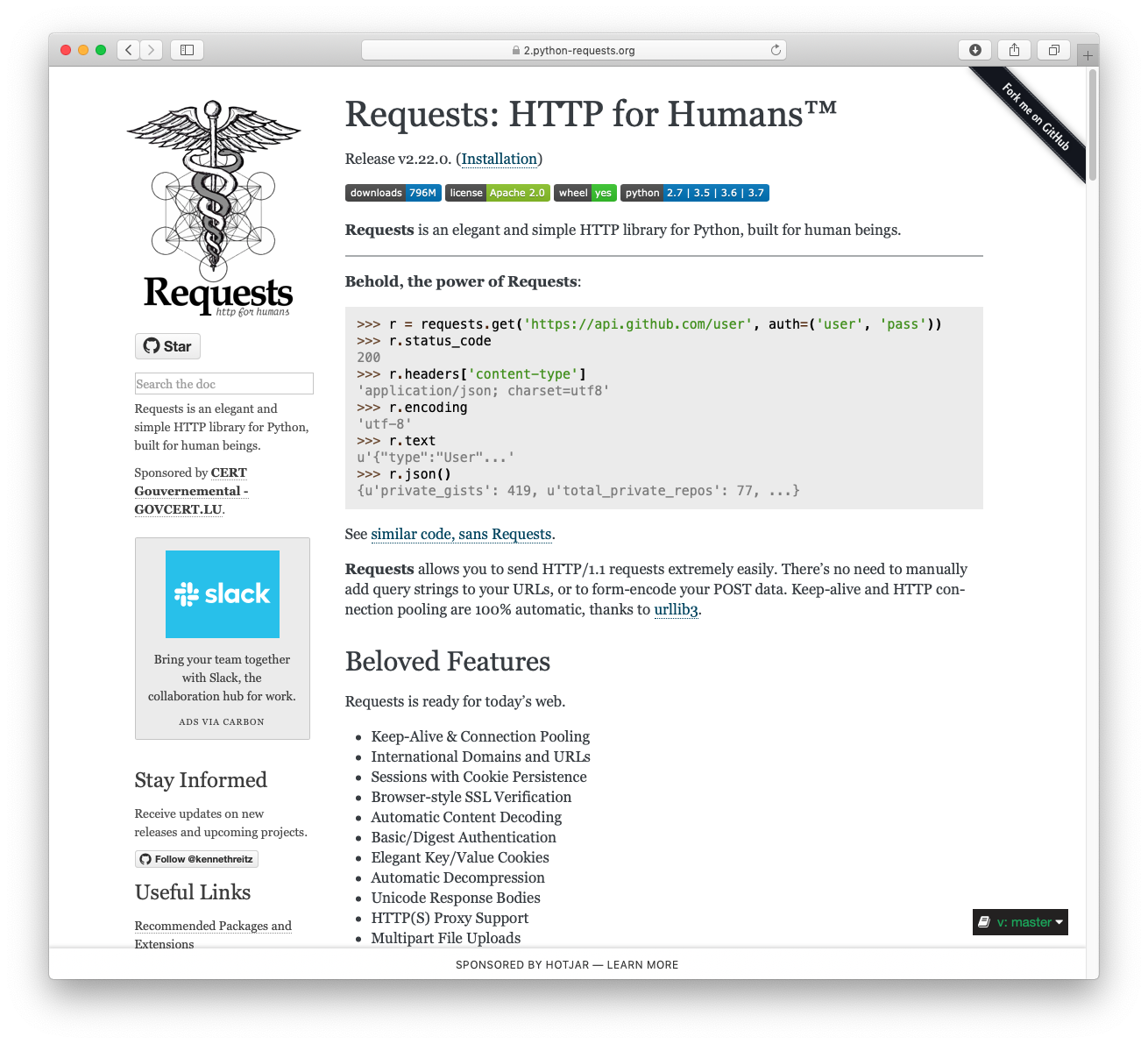
Requests
Requests is a simple, yet elegant, HTTP library.
>>> import requests
>>> r = requests.get('https://api.github.com/user', auth=('user', 'pass'))
>>> r.status_code
200
>>> r.headers['content-type']
'application/json; charset=utf8'
>>> r.encoding
'utf-8'
>>> r.text
'{"type":"User"...'
>>> r.json()
{'disk_usage': 368627, 'private_gists': 484, ...}
Requests allows you to send HTTP/1.1 requests extremely easily. There’s no need to manually add query strings to your URLs, or to form-encode your PUT & POST data — but nowadays, just use the json method!
Requests is one of the most downloaded Python package today, pulling in around 14M downloads / week— according to GitHub, Requests is currently depended upon by 500,000+ repositories. You may certainly put your trust in this code.


Installing Requests and Supported Versions
Requests is available on PyPI:
$ python -m pip install requests
Requests officially supports Python 2.7 & 3.5+.
Supported Features & Best–Practices
Requests is ready for the demands of building robust and reliable HTTP–speaking applications, for the needs of today.
- Keep-Alive & Connection Pooling
- International Domains and URLs
- Sessions with Cookie Persistence
- Browser-style TLS/SSL Verification
- Basic & Digest Authentication
- Familiar
dict–like Cookies - Automatic Content Decompression and Decoding
- Multi-part File Uploads
- SOCKS Proxy Support
- Connection Timeouts
- Streaming Downloads
- Automatic honoring of
.netrc - Chunked HTTP Requests
API Reference and User Guide available on Read the Docs
Cloning the repository
When cloning the Requests repository, you may need to add the -c fetch.fsck.badTimezone=ignore flag to avoid an error about a bad commit (see
this issue for more background):
git clone -c fetch.fsck.badTimezone=ignore https://github.com/psf/requests.git
You can also apply this setting to your global Git config:
git config --global fetch.fsck.badTimezone ignore