mirror of
https://github.com/kennethreitz/responder.git
synced 2026-06-05 23:00:17 +00:00
 Taoufik
71 lines
4.0 KiB
Markdown
71 lines
4.0 KiB
Markdown
# Responder: a familiar HTTP Service Framework for Python
|
|
|
|
[](https://travis-ci.org/taoufik07/responder)
|
|
[](https://responder.readthedocs.io/en/latest/)
|
|
[](https://pypi.org/project/responder/)
|
|
[](https://pypi.org/project/responder/)
|
|
[](https://pypi.org/project/responder/)
|
|
[](https://github.com/taoufik07/responder/graphs/contributors)
|
|
|
|
[](https://responder.readthedocs.io)
|
|
|
|
|
|
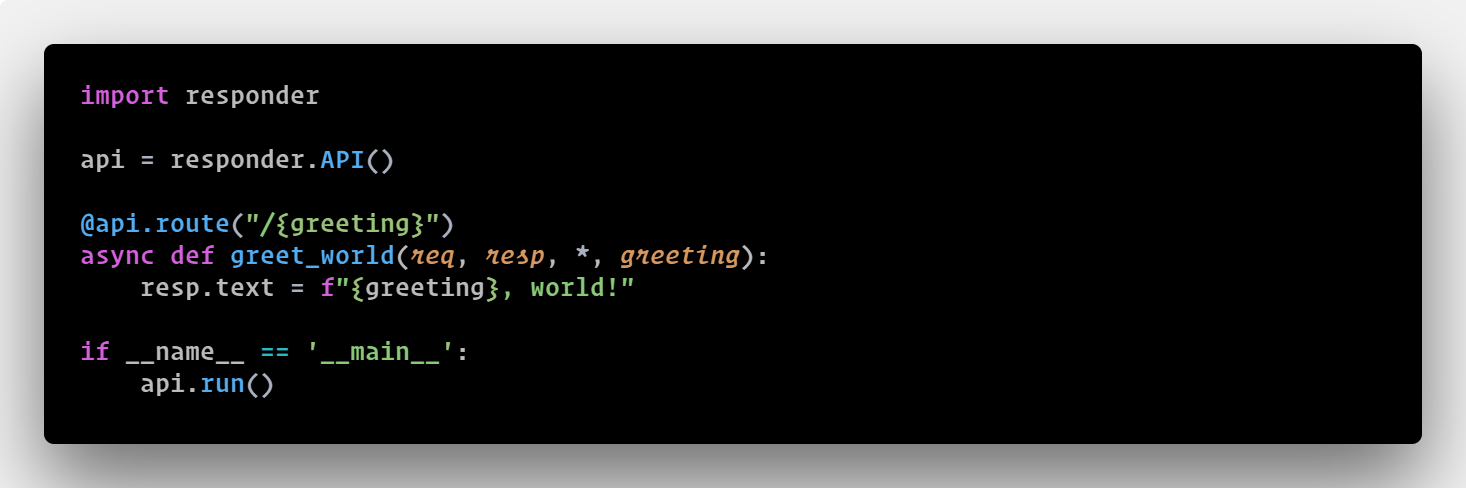
Powered by [Starlette](https://www.starlette.io/). That `async` declaration is optional. [View documentation](https://responder.readthedocs.io).
|
|
|
|
This gets you a ASGI app, with a production static files server pre-installed, jinja2 templating (without additional imports), and a production webserver based on uvloop, serving up requests with gzip compression automatically.
|
|
|
|
|
|
## Testimonials
|
|
|
|
> "Pleasantly very taken with python-responder. [@kennethreitz](https://twitter.com/kennethreitz) at his absolute best." —Rudraksh M.K.
|
|
|
|
> "ASGI is going to enable all sorts of new high-performance web services. It's awesome to see Responder starting to take advantage of that." — Tom Christie author of [Django REST Framework](https://www.django-rest-framework.org/)
|
|
|
|
> "I love that you are exploring new patterns. Go go go!" — Danny Greenfield, author of [Two Scoops of Django]()
|
|
|
|
|
|
## More Examples
|
|
|
|
See [the documentation's feature tour](https://responder.readthedocs.io/en/latest/tour.html) for more details on features available in Responder.
|
|
|
|
|
|
# Installing Responder
|
|
|
|
Install the stable release:
|
|
|
|
|
|
$ pipenv install responder
|
|
✨🍰✨
|
|
|
|
|
|
Or, install from the development branch:
|
|
|
|
$ pipenv install -e git+https://github.com/taoufik07/responder.git#egg=responder
|
|
|
|
Only **Python 3.6+** is supported.
|
|
|
|
|
|
# The Basic Idea
|
|
|
|
The primary concept here is to bring the niceties that are brought forth from both Flask and Falcon and unify them into a single framework, along with some new ideas I have. I also wanted to take some of the API primitives that are instilled in the Requests library and put them into a web framework. So, you'll find a lot of parallels here with Requests.
|
|
|
|
- Setting `resp.content` sends back bytes.
|
|
- Setting `resp.text` sends back unicode, while setting `resp.html` sends back HTML.
|
|
- Setting `resp.media` sends back JSON/YAML (`.text`/`.html`/`.content` override this).
|
|
- Case-insensitive `req.headers` dict (from Requests directly).
|
|
- `resp.status_code`, `req.method`, `req.url`, and other familiar friends.
|
|
|
|
|
|
## Ideas
|
|
|
|
- Flask-style route expression, with new capabilities -- all while using Python 3.6+'s new f-string syntax.
|
|
- I love Falcon's "every request and response is passed into to each view and mutated" methodology, especially `response.media`, and have used it here. In addition to supporting JSON, I have decided to support YAML as well, as Kubernetes is slowly taking over the world, and it uses YAML for all the things. Content-negotiation and all that.
|
|
- **A built in testing client that uses the actual Requests you know and love**.
|
|
- The ability to mount other WSGI apps easily.
|
|
- Automatic gzipped-responses.
|
|
- In addition to Falcon's `on_get`, `on_post`, etc methods, Responder features an `on_request` method, which gets called on every type of request, much like Requests.
|
|
- A production static file server is built-in.
|
|
- Uvicorn built-in as a production web server. I would have chosen Gunicorn, but it doesn't run on Windows. Plus, Uvicorn serves well to protect against slowloris attacks, making nginx unnecessary in production.
|
|
- GraphQL support, via Graphene. The goal here is to have any GraphQL query exposable at any route, magically.
|
|
- Provide an official way to run webpack.
|