mirror of
https://github.com/kennethreitz/responder.git
synced 2026-06-05 23:00:17 +00:00
Compare commits
1 Commits
| Author | SHA1 | Date | |
|---|---|---|---|
 Andreas Motl Andreas Motl
|
cc0fe78382 |
@@ -1,3 +0,0 @@
|
||||
github: kennethreitz
|
||||
thanks_dev: kennethreitz
|
||||
custom: https://cash.app/$KennethReitz
|
||||
@@ -1,42 +0,0 @@
|
||||
name: "Documentation"
|
||||
|
||||
on:
|
||||
push:
|
||||
branches: [ main ]
|
||||
pull_request: ~
|
||||
workflow_dispatch:
|
||||
|
||||
# Cancel redundant in-progress jobs.
|
||||
concurrency:
|
||||
group: ${{ github.workflow }}-${{ github.ref }}
|
||||
cancel-in-progress: true
|
||||
|
||||
jobs:
|
||||
|
||||
documentation:
|
||||
name: "Documentation"
|
||||
runs-on: ubuntu-latest
|
||||
env:
|
||||
UV_SYSTEM_PYTHON: true
|
||||
|
||||
steps:
|
||||
- uses: actions/checkout@v4
|
||||
|
||||
- name: Set up Python
|
||||
uses: actions/setup-python@v5
|
||||
with:
|
||||
python-version: "3.13"
|
||||
|
||||
- name: Set up uv
|
||||
uses: astral-sh/setup-uv@v5
|
||||
with:
|
||||
version: "latest"
|
||||
enable-cache: true
|
||||
cache-dependency-glob: |
|
||||
pyproject.toml
|
||||
|
||||
- name: Install package and documentation dependencies
|
||||
run: uv pip install '.[docs]'
|
||||
|
||||
- name: Build static HTML documentation
|
||||
run: sphinx-build -W --keep-going docs/source docs/build
|
||||
+13
-28
@@ -12,45 +12,30 @@ concurrency:
|
||||
cancel-in-progress: true
|
||||
|
||||
jobs:
|
||||
|
||||
test:
|
||||
name: "Python ${{ matrix.python-version }}"
|
||||
runs-on: ubuntu-latest
|
||||
name: "Python ${{ matrix.python-version }} on ${{ matrix.os }}"
|
||||
runs-on: ${{ matrix.os }}
|
||||
strategy:
|
||||
fail-fast: false
|
||||
matrix:
|
||||
os: [
|
||||
"ubuntu-latest",
|
||||
"macos-12",
|
||||
"macos-latest",
|
||||
]
|
||||
python-version: [
|
||||
"3.9",
|
||||
"3.10",
|
||||
"3.11",
|
||||
"3.12",
|
||||
"3.13",
|
||||
"pypy3.10",
|
||||
]
|
||||
env:
|
||||
UV_SYSTEM_PYTHON: true
|
||||
|
||||
steps:
|
||||
- uses: actions/checkout@v4
|
||||
- uses: actions/setup-node@v4
|
||||
with:
|
||||
node-version: 22
|
||||
|
||||
- name: Set up Python
|
||||
uses: actions/setup-python@v5
|
||||
- uses: actions/checkout@v3
|
||||
- uses: actions/setup-python@v5
|
||||
with:
|
||||
python-version: ${{ matrix.python-version }}
|
||||
|
||||
- name: Set up uv
|
||||
uses: astral-sh/setup-uv@v5
|
||||
with:
|
||||
version: "latest"
|
||||
enable-cache: true
|
||||
cache-suffix: ${{ matrix.python-version }}
|
||||
cache-dependency-glob: |
|
||||
pyproject.toml
|
||||
|
||||
- name: Install package
|
||||
run: uv pip install '.[develop,test]'
|
||||
|
||||
- name: Run tests
|
||||
run: pytest
|
||||
- uses: yezz123/setup-uv@v4
|
||||
- run: uv pip install --editable '.[graphql,develop,test]' --system
|
||||
- run: poe check
|
||||
|
||||
@@ -7,7 +7,6 @@
|
||||
.pytest_cache
|
||||
.DS_Store
|
||||
coverage.xml
|
||||
.coverage*
|
||||
|
||||
__pycache__
|
||||
tests/__pycache__
|
||||
|
||||
@@ -1,33 +0,0 @@
|
||||
# .readthedocs.yml
|
||||
# Read the Docs configuration file
|
||||
|
||||
# Details
|
||||
# - https://docs.readthedocs.io/en/stable/config-file/v2.html
|
||||
|
||||
# Required
|
||||
version: 2
|
||||
|
||||
build:
|
||||
os: "ubuntu-24.04"
|
||||
tools:
|
||||
python: "3.12"
|
||||
|
||||
python:
|
||||
install:
|
||||
- method: pip
|
||||
path: .
|
||||
extra_requirements:
|
||||
- docs
|
||||
|
||||
sphinx:
|
||||
configuration: docs/source/conf.py
|
||||
|
||||
# Use standard HTML builder.
|
||||
builder: html
|
||||
|
||||
# Fail on all warnings to avoid broken references.
|
||||
fail_on_warning: true
|
||||
|
||||
# Optionally build your docs in additional formats such as PDF
|
||||
#formats:
|
||||
# - pdf
|
||||
+46
-87
@@ -7,46 +7,6 @@ this project adheres to [Semantic Versioning](https://semver.org/spec/v2.0.0.htm
|
||||
|
||||
## [Unreleased]
|
||||
|
||||
## [v3.0.0] - 2026-03-22
|
||||
|
||||
### Added
|
||||
|
||||
- Platform: Added support for Python 3.10 - Python 3.13
|
||||
- CLI: `responder run` now also accepts a filesystem path on its `<target>`
|
||||
argument, enabling usage on single-file applications.
|
||||
- CLI: `responder run` now also accepts URLs.
|
||||
|
||||
### Changed
|
||||
|
||||
- Platform: Minimum Python version is now 3.9 (dropped 3.6, 3.7, 3.8)
|
||||
- Dependencies: Dramatically reduced core dependency count (10 → 5)
|
||||
- Removed `requests`, `requests-toolbelt`, `rfc3986`, `whitenoise`
|
||||
- Moved `apispec` and `marshmallow` to `openapi` optional extra
|
||||
- Replaced `rfc3986` with stdlib `urllib.parse`
|
||||
- Replaced `requests-toolbelt` multipart decoder with `python-multipart`
|
||||
- Replaced deprecated `starlette.middleware.wsgi` with `a2wsgi`
|
||||
- Switched from WhiteNoise to ServeStatic
|
||||
- Dependencies: Pinned `starlette[full]>=0.40` (was unpinned)
|
||||
- GraphQL: Upgraded to `graphene>=3` and `graphql-core>=3.1`
|
||||
(from `graphene<3` and `graphql-server-core`, which is unmaintained)
|
||||
- GraphQL: Updated GraphiQL UI from 0.12.0 (2018) to 3.0.6 with React 18
|
||||
- Extensions: All of CLI-, GraphQL-, and OpenAPI-Support modules are
|
||||
extensions now, found within the `responder.ext` module namespace.
|
||||
- Packaging: Migrated from `setup.py` to declarative `pyproject.toml`
|
||||
|
||||
### Removed
|
||||
|
||||
- Platform: Removed support for EOL Python 3.6, 3.7, 3.8
|
||||
- Status codes: Removed deprecated `resume_incomplete` and `resume`
|
||||
aliases for HTTP 308 (marked for removal in 3.0)
|
||||
- CLI: `responder run --build` ceased to exist
|
||||
|
||||
### Fixed
|
||||
|
||||
- Routing: Fixed dispatching `static_route=None` on Windows
|
||||
- uvicorn: `--debug` now maps to uvicorn's `log_level = "debug"`
|
||||
- Tests: Fixed deprecated httpx TestClient usage
|
||||
|
||||
## [v2.0.5] - 2019-12-15
|
||||
|
||||
### Added
|
||||
@@ -373,50 +333,49 @@ this project adheres to [Semantic Versioning](https://semver.org/spec/v2.0.0.htm
|
||||
|
||||
- Conception!
|
||||
|
||||
[unreleased]: https://github.com/kennethreitz/responder/compare/v3.0.0..HEAD
|
||||
[v3.0.0]: https://github.com/kennethreitz/responder/compare/v2.0.5..v3.0.0
|
||||
[v2.0.5]: https://github.com/kennethreitz/responder/compare/v2.0.4..v2.0.5
|
||||
[v2.0.4]: https://github.com/kennethreitz/responder/compare/v2.0.3..v2.0.4
|
||||
[v2.0.3]: https://github.com/kennethreitz/responder/compare/v2.0.2..v2.0.3
|
||||
[v2.0.2]: https://github.com/kennethreitz/responder/compare/v2.0.1..v2.0.2
|
||||
[v2.0.1]: https://github.com/kennethreitz/responder/compare/v2.0.0..v2.0.1
|
||||
[v2.0.0]: https://github.com/kennethreitz/responder/compare/v1.3.2..v2.0.0
|
||||
[v1.3.2]: https://github.com/kennethreitz/responder/compare/v1.3.1..v1.3.2
|
||||
[v1.3.1]: https://github.com/kennethreitz/responder/compare/v1.3.0..v1.3.1
|
||||
[v1.3.0]: https://github.com/kennethreitz/responder/compare/v1.2.0..v1.3.0
|
||||
[v1.2.0]: https://github.com/kennethreitz/responder/compare/v1.1.3..v1.2.0
|
||||
[v1.1.3]: https://github.com/kennethreitz/responder/compare/v1.1.2..v1.1.3
|
||||
[v1.1.2]: https://github.com/kennethreitz/responder/compare/v1.1.1..v1.1.2
|
||||
[v1.1.1]: https://github.com/kennethreitz/responder/compare/v1.1.0..v1.1.1
|
||||
[v1.1.0]: https://github.com/kennethreitz/responder/compare/v1.0.5..v1.1.0
|
||||
[v1.0.5]: https://github.com/kennethreitz/responder/compare/v1.0.4..v1.0.5
|
||||
[v1.0.4]: https://github.com/kennethreitz/responder/compare/v1.0.3..v1.0.4
|
||||
[v1.0.3]: https://github.com/kennethreitz/responder/compare/v1.0.2..v1.0.3
|
||||
[v1.0.2]: https://github.com/kennethreitz/responder/compare/v1.0.1..v1.0.2
|
||||
[v1.0.1]: https://github.com/kennethreitz/responder/compare/v1.0.0..v1.0.1
|
||||
[v1.0.0]: https://github.com/kennethreitz/responder/compare/v0.3.3..v1.0.0
|
||||
[v0.3.3]: https://github.com/kennethreitz/responder/compare/v0.3.2..v0.3.3
|
||||
[v0.3.2]: https://github.com/kennethreitz/responder/compare/v0.3.1..v0.3.2
|
||||
[v0.3.1]: https://github.com/kennethreitz/responder/compare/v0.3.0..v0.3.1
|
||||
[v0.3.0]: https://github.com/kennethreitz/responder/compare/v0.2.3..v0.3.0
|
||||
[v0.2.3]: https://github.com/kennethreitz/responder/compare/v0.2.2..v0.2.3
|
||||
[v0.2.2]: https://github.com/kennethreitz/responder/compare/v0.2.1..v0.2.2
|
||||
[v0.2.1]: https://github.com/kennethreitz/responder/compare/v0.2.0..v0.2.1
|
||||
[v0.2.0]: https://github.com/kennethreitz/responder/compare/v0.1.6..v0.2.0
|
||||
[v0.1.6]: https://github.com/kennethreitz/responder/compare/v0.1.5..v0.1.6
|
||||
[v0.1.5]: https://github.com/kennethreitz/responder/compare/v0.1.4..v0.1.5
|
||||
[v0.1.4]: https://github.com/kennethreitz/responder/compare/v0.1.3..v0.1.4
|
||||
[v0.1.3]: https://github.com/kennethreitz/responder/compare/v0.1.2..v0.1.3
|
||||
[v0.1.2]: https://github.com/kennethreitz/responder/compare/v0.1.1..v0.1.2
|
||||
[v0.1.1]: https://github.com/kennethreitz/responder/compare/v0.1.0..v0.1.1
|
||||
[v0.1.0]: https://github.com/kennethreitz/responder/compare/v0.0.10..v0.1.0
|
||||
[v0.0.10]: https://github.com/kennethreitz/responder/compare/v0.0.9..v0.0.10
|
||||
[v0.0.9]: https://github.com/kennethreitz/responder/compare/v0.0.8..v0.0.9
|
||||
[v0.0.8]: https://github.com/kennethreitz/responder/compare/v0.0.7..v0.0.8
|
||||
[v0.0.7]: https://github.com/kennethreitz/responder/compare/v0.0.6..v0.0.7
|
||||
[v0.0.6]: https://github.com/kennethreitz/responder/compare/v0.0.5..v0.0.6
|
||||
[v0.0.5]: https://github.com/kennethreitz/responder/compare/v0.0.4..v0.0.5
|
||||
[v0.0.4]: https://github.com/kennethreitz/responder/compare/v0.0.3..v0.0.4
|
||||
[v0.0.3]: https://github.com/kennethreitz/responder/compare/v0.0.2..v0.0.3
|
||||
[v0.0.2]: https://github.com/kennethreitz/responder/compare/v0.0.1..v0.0.2
|
||||
[v0.0.1]: https://github.com/kennethreitz/responder/compare/v0.0.0..v0.0.1
|
||||
[unreleased]: https://github.com/taoufik07/responder/compare/v2.0.5..HEAD
|
||||
[v2.0.5]: https://github.com/taoufik07/responder/compare/v2.0.4..v2.0.5
|
||||
[v2.0.4]: https://github.com/taoufik07/responder/compare/v2.0.3..v2.0.4
|
||||
[v2.0.3]: https://github.com/taoufik07/responder/compare/v2.0.2..v2.0.3
|
||||
[v2.0.2]: https://github.com/taoufik07/responder/compare/v2.0.1..v2.0.2
|
||||
[v2.0.1]: https://github.com/taoufik07/responder/compare/v2.0.0..v2.0.1
|
||||
[v2.0.0]: https://github.com/taoufik07/responder/compare/v1.3.2..v2.0.0
|
||||
[v1.3.2]: https://github.com/taoufik07/responder/compare/v1.3.1..v1.3.2
|
||||
[v1.3.1]: https://github.com/taoufik07/responder/compare/v1.3.0..v1.3.1
|
||||
[v1.3.0]: https://github.com/taoufik07/responder/compare/v1.2.0..v1.3.0
|
||||
[v1.2.0]: https://github.com/taoufik07/responder/compare/v1.1.3..v1.2.0
|
||||
[v1.1.3]: https://github.com/taoufik07/responder/compare/v1.1.2..v1.1.3
|
||||
[v1.1.2]: https://github.com/taoufik07/responder/compare/v1.1.1..v1.1.2
|
||||
[v1.1.1]: https://github.com/taoufik07/responder/compare/v1.1.0..v1.1.1
|
||||
[v1.1.0]: https://github.com/taoufik07/responder/compare/v1.0.5..v1.1.0
|
||||
[v1.0.5]: https://github.com/taoufik07/responder/compare/v1.0.4..v1.0.5
|
||||
[v1.0.4]: https://github.com/taoufik07/responder/compare/v1.0.3..v1.0.4
|
||||
[v1.0.3]: https://github.com/taoufik07/responder/compare/v1.0.2..v1.0.3
|
||||
[v1.0.2]: https://github.com/taoufik07/responder/compare/v1.0.1..v1.0.2
|
||||
[v1.0.1]: https://github.com/taoufik07/responder/compare/v1.0.0..v1.0.1
|
||||
[v1.0.0]: https://github.com/taoufik07/responder/compare/v0.3.3..v1.0.0
|
||||
[v0.3.3]: https://github.com/taoufik07/responder/compare/v0.3.2..v0.3.3
|
||||
[v0.3.2]: https://github.com/taoufik07/responder/compare/v0.3.1..v0.3.2
|
||||
[v0.3.1]: https://github.com/taoufik07/responder/compare/v0.3.0..v0.3.1
|
||||
[v0.3.0]: https://github.com/taoufik07/responder/compare/v0.2.3..v0.3.0
|
||||
[v0.2.3]: https://github.com/taoufik07/responder/compare/v0.2.2..v0.2.3
|
||||
[v0.2.2]: https://github.com/taoufik07/responder/compare/v0.2.1..v0.2.2
|
||||
[v0.2.1]: https://github.com/taoufik07/responder/compare/v0.2.0..v0.2.1
|
||||
[v0.2.0]: https://github.com/taoufik07/responder/compare/v0.1.6..v0.2.0
|
||||
[v0.1.6]: https://github.com/taoufik07/responder/compare/v0.1.5..v0.1.6
|
||||
[v0.1.5]: https://github.com/taoufik07/responder/compare/v0.1.4..v0.1.5
|
||||
[v0.1.4]: https://github.com/taoufik07/responder/compare/v0.1.3..v0.1.4
|
||||
[v0.1.3]: https://github.com/taoufik07/responder/compare/v0.1.2..v0.1.3
|
||||
[v0.1.2]: https://github.com/taoufik07/responder/compare/v0.1.1..v0.1.2
|
||||
[v0.1.1]: https://github.com/taoufik07/responder/compare/v0.1.0..v0.1.1
|
||||
[v0.1.0]: https://github.com/taoufik07/responder/compare/v0.0.10..v0.1.0
|
||||
[v0.0.10]: https://github.com/taoufik07/responder/compare/v0.0.9..v0.0.10
|
||||
[v0.0.9]: https://github.com/taoufik07/responder/compare/v0.0.8..v0.0.9
|
||||
[v0.0.8]: https://github.com/taoufik07/responder/compare/v0.0.7..v0.0.8
|
||||
[v0.0.7]: https://github.com/taoufik07/responder/compare/v0.0.6..v0.0.7
|
||||
[v0.0.6]: https://github.com/taoufik07/responder/compare/v0.0.5..v0.0.6
|
||||
[v0.0.5]: https://github.com/taoufik07/responder/compare/v0.0.4..v0.0.5
|
||||
[v0.0.4]: https://github.com/taoufik07/responder/compare/v0.0.3..v0.0.4
|
||||
[v0.0.3]: https://github.com/taoufik07/responder/compare/v0.0.2..v0.0.3
|
||||
[v0.0.2]: https://github.com/taoufik07/responder/compare/v0.0.1..v0.0.2
|
||||
[v0.0.1]: https://github.com/taoufik07/responder/compare/v0.0.0..v0.0.1
|
||||
|
||||
+33
@@ -0,0 +1,33 @@
|
||||
# Development Sandbox
|
||||
|
||||
## Setup
|
||||
|
||||
Acquire sources and install project in editable mode.
|
||||
```shell
|
||||
git clone https://github.com/kennethreitz/responder
|
||||
cd responder
|
||||
python3 -m venv .venv
|
||||
source .venv/bin/activate
|
||||
pip install --editable '.[graphql,develop,release,test]'
|
||||
```
|
||||
|
||||
## Operations
|
||||
|
||||
Invoke linter and software tests.
|
||||
```shell
|
||||
poe check
|
||||
```
|
||||
|
||||
Format code.
|
||||
```shell
|
||||
poe format
|
||||
```
|
||||
|
||||
|
||||
## Release
|
||||
|
||||
```shell
|
||||
git tag v2.1.0
|
||||
git push --tags
|
||||
poe release
|
||||
```
|
||||
@@ -0,0 +1 @@
|
||||
include LICENSE
|
||||
@@ -1,109 +1,91 @@
|
||||
# Responder
|
||||
# Responder: a familiar HTTP Service Framework for Python
|
||||
|
||||
A familiar HTTP Service Framework for Python, powered by [Starlette](https://www.starlette.io/).
|
||||
[](https://github.com/kennethreitz/responder/actions/workflows/test.yaml)
|
||||
[](https://responder.kennethreitz.org/)
|
||||
[](https://pypi.org/project/responder/)
|
||||
[](https://pypi.org/project/responder/)
|
||||
[](https://pypi.org/project/responder/)
|
||||
[](https://github.com/kennethreitz/responder/graphs/contributors)
|
||||
[](https://pepy.tech/project/responder/)
|
||||
[](https://pypi.org/project/responder/)
|
||||
[](https://pypi.org/project/responder/)
|
||||
|
||||
```python
|
||||
import responder
|
||||
[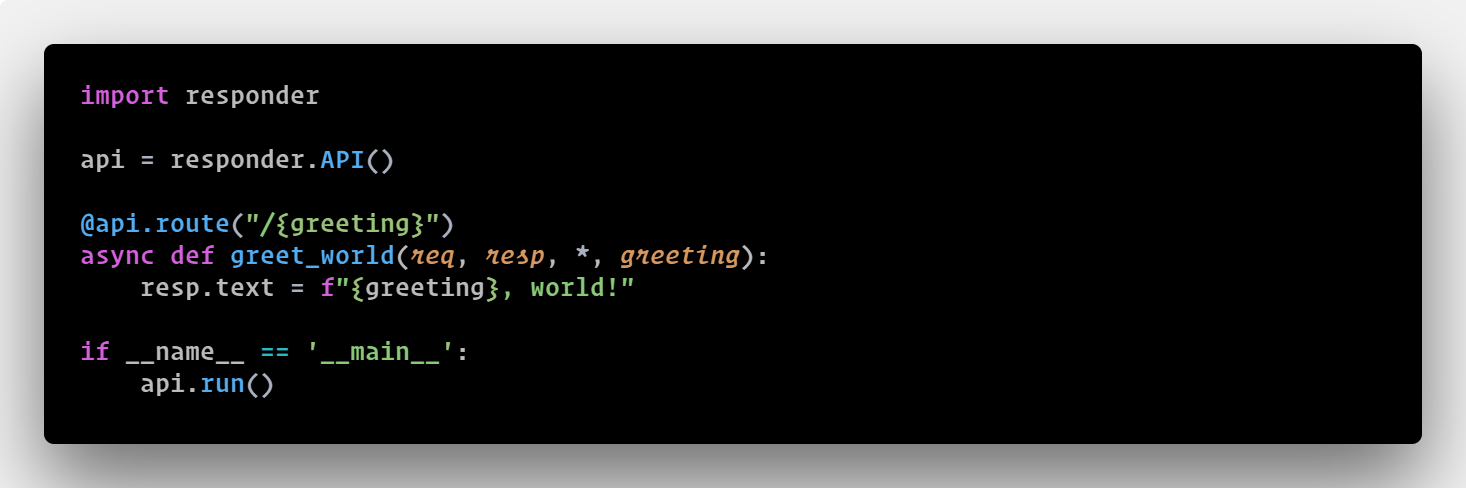](https://responder.readthedocs.io)
|
||||
|
||||
api = responder.API()
|
||||
Powered by [Starlette](https://www.starlette.io/). That `async` declaration is optional.
|
||||
[View documentation](https://responder.readthedocs.io).
|
||||
|
||||
@api.route("/{greeting}")
|
||||
async def greet_world(req, resp, *, greeting):
|
||||
resp.text = f"{greeting}, world!"
|
||||
This gets you a ASGI app, with a production static files server pre-installed, jinja2
|
||||
templating (without additional imports), and a production webserver based on uvloop,
|
||||
serving up requests with gzip compression automatically.
|
||||
|
||||
if __name__ == "__main__":
|
||||
api.run()
|
||||
```
|
||||
## Testimonials
|
||||
|
||||
$ pip install responder
|
||||
> "Pleasantly very taken with python-responder.
|
||||
> [@kennethreitz](https://twitter.com/kennethreitz) at his absolute best." —Rudraksh
|
||||
> M.K.
|
||||
|
||||
That's it. Supports Python 3.9+.
|
||||
> "ASGI is going to enable all sorts of new high-performance web services. It's awesome
|
||||
> to see Responder starting to take advantage of that." — Tom Christie author of
|
||||
> [Django REST Framework](https://www.django-rest-framework.org/)
|
||||
|
||||
## The Basics
|
||||
> "I love that you are exploring new patterns. Go go go!" — Danny Greenfield, author of
|
||||
> [Two Scoops of Django]()
|
||||
|
||||
- `resp.text` sends back text. `resp.html` sends back HTML. `resp.content` sends back bytes.
|
||||
- `resp.media` sends back JSON (or YAML, with content negotiation).
|
||||
- `resp.file("path.pdf")` serves a file with automatic content-type detection.
|
||||
- `req.headers` is case-insensitive. `req.params` gives you query parameters.
|
||||
- Both sync and async views work — the `async` is optional.
|
||||
## More Examples
|
||||
|
||||
## Highlights
|
||||
See
|
||||
[the documentation's feature tour](https://responder.readthedocs.io/en/latest/tour.html)
|
||||
for more details on features available in Responder.
|
||||
|
||||
```python
|
||||
# Type-safe route parameters
|
||||
@api.route("/users/{user_id:int}")
|
||||
async def get_user(req, resp, *, user_id):
|
||||
resp.media = {"id": user_id}
|
||||
# Installing Responder
|
||||
|
||||
# HTTP method filtering
|
||||
@api.route("/items", methods=["POST"])
|
||||
async def create_item(req, resp):
|
||||
data = await req.media()
|
||||
resp.media = {"created": data}
|
||||
Install the most recent stable release:
|
||||
|
||||
# Class-based views
|
||||
@api.route("/things/{id}")
|
||||
class ThingResource:
|
||||
def on_get(self, req, resp, *, id):
|
||||
resp.media = {"id": id}
|
||||
def on_post(self, req, resp, *, id):
|
||||
resp.text = "created"
|
||||
pip install --upgrade responder
|
||||
|
||||
# Before-request hooks (auth, rate limiting, etc.)
|
||||
@api.route(before_request=True)
|
||||
def check_auth(req, resp):
|
||||
if not req.headers.get("Authorization"):
|
||||
resp.status_code = 401
|
||||
resp.media = {"error": "unauthorized"}
|
||||
Or, install directly from the repository:
|
||||
|
||||
# Custom error handling
|
||||
@api.exception_handler(ValueError)
|
||||
async def handle_error(req, resp, exc):
|
||||
resp.status_code = 400
|
||||
resp.media = {"error": str(exc)}
|
||||
pip install 'responder @ git+https://github.com/kennethreitz/responder.git'
|
||||
|
||||
# Lifespan events
|
||||
from contextlib import asynccontextmanager
|
||||
Only **Python 3.6+** is supported.
|
||||
|
||||
@asynccontextmanager
|
||||
async def lifespan(app):
|
||||
print("starting up")
|
||||
yield
|
||||
print("shutting down")
|
||||
# The Basic Idea
|
||||
|
||||
api = responder.API(lifespan=lifespan)
|
||||
The primary concept here is to bring the niceties that are brought forth from both Flask
|
||||
and Falcon and unify them into a single framework, along with some new ideas I have. I
|
||||
also wanted to take some of the API primitives that are instilled in the Requests
|
||||
library and put them into a web framework. So, you'll find a lot of parallels here with
|
||||
Requests.
|
||||
|
||||
# GraphQL
|
||||
import graphene
|
||||
api.graphql("/graphql", schema=graphene.Schema(query=Query))
|
||||
- Setting `resp.content` sends back bytes.
|
||||
- Setting `resp.text` sends back unicode, while setting `resp.html` sends back HTML.
|
||||
- Setting `resp.media` sends back JSON/YAML (`.text`/`.html`/`.content` override this).
|
||||
- Case-insensitive `req.headers` dict (from Requests directly).
|
||||
- `resp.status_code`, `req.method`, `req.url`, and other familiar friends.
|
||||
|
||||
# WebSockets
|
||||
@api.route("/ws", websocket=True)
|
||||
async def websocket(ws):
|
||||
await ws.accept()
|
||||
while True:
|
||||
name = await ws.receive_text()
|
||||
await ws.send_text(f"Hello {name}!")
|
||||
## Ideas
|
||||
|
||||
# Mount WSGI/ASGI apps
|
||||
from flask import Flask
|
||||
flask_app = Flask(__name__)
|
||||
api.mount("/flask", flask_app)
|
||||
- Flask-style route expression, with new capabilities -- all while using Python 3.6+'s
|
||||
new f-string syntax.
|
||||
- I love Falcon's "every request and response is passed into to each view and mutated"
|
||||
methodology, especially `response.media`, and have used it here. In addition to
|
||||
supporting JSON, I have decided to support YAML as well, as Kubernetes is slowly
|
||||
taking over the world, and it uses YAML for all the things. Content-negotiation and
|
||||
all that.
|
||||
- **A built in testing client that uses the actual Requests you know and love**.
|
||||
- The ability to mount other WSGI apps easily.
|
||||
- Automatic gzipped-responses.
|
||||
- In addition to Falcon's `on_get`, `on_post`, etc methods, Responder features an
|
||||
`on_request` method, which gets called on every type of request, much like Requests.
|
||||
- A production static file server is built-in.
|
||||
- Uvicorn built-in as a production web server. I would have chosen Gunicorn, but it
|
||||
doesn't run on Windows. Plus, Uvicorn serves well to protect against slowloris
|
||||
attacks, making nginx unnecessary in production.
|
||||
- GraphQL support, via Graphene. The goal here is to have any GraphQL query exposable at
|
||||
any route, magically.
|
||||
- Provide an official way to run webpack.
|
||||
|
||||
# Background tasks
|
||||
@api.route("/work")
|
||||
def do_work(req, resp):
|
||||
@api.background.task
|
||||
def process():
|
||||
import time; time.sleep(10)
|
||||
process()
|
||||
resp.media = {"status": "processing"}
|
||||
```
|
||||
## Development
|
||||
|
||||
Built-in OpenAPI docs, cookie-based sessions, gzip compression, static file serving, Jinja2 templates, and a production uvicorn server.
|
||||
|
||||
Route convertors: `str`, `int`, `float`, `uuid`, `path`.
|
||||
|
||||
## Documentation
|
||||
|
||||
https://responder.kennethreitz.org
|
||||
See [Development Sandbox](DEVELOP.md).
|
||||
|
||||
@@ -0,0 +1,37 @@
|
||||
# ruff: noqa: S605, S607
|
||||
"""
|
||||
Build and publish a .deb package.
|
||||
https://pypi.python.org/pypi/stdeb/0.8.5#quickstart-2-just-tell-me-the-fastest-way-to-make-a-deb
|
||||
"""
|
||||
|
||||
import os
|
||||
from shutil import rmtree
|
||||
|
||||
here = os.path.abspath(os.path.dirname(__file__))
|
||||
|
||||
|
||||
def get_version():
|
||||
import responder
|
||||
|
||||
return responder.__version__
|
||||
|
||||
|
||||
def run():
|
||||
version = get_version()
|
||||
try:
|
||||
print("Removing previous builds")
|
||||
rmtree(os.path.join(here, "deb_dist"))
|
||||
except FileNotFoundError:
|
||||
pass
|
||||
print("Creating Debian package manifest")
|
||||
os.system(
|
||||
"python setup.py --command-packages=stdeb.command sdist_dsc "
|
||||
"-z artful --package3=pipenv --depends3=python3-virtualenv-clone"
|
||||
)
|
||||
print("Building .deb")
|
||||
os.chdir(f"deb_dist/pipenv-{version}")
|
||||
os.system("dpkg-buildpackage -rfakeroot -uc -us")
|
||||
|
||||
|
||||
if __name__ == "__main__":
|
||||
run()
|
||||
@@ -0,0 +1,6 @@
|
||||
alabaster<0.8
|
||||
jinja2<3.2
|
||||
markupsafe<4
|
||||
readme-renderer<45
|
||||
sphinx>=5,<9
|
||||
sphinxcontrib-websupport<2.1
|
||||
@@ -3,8 +3,6 @@
|
||||
type="text/css"
|
||||
href="https://cloud.typography.com/7584432/7586812/css/fonts.css"
|
||||
/>
|
||||
<script async defer src="https://buttons.github.io/buttons.js"></script>
|
||||
|
||||
<script type="text/javascript">
|
||||
$("#searchbox").hide(0);
|
||||
</script>
|
||||
|
||||
@@ -7,13 +7,16 @@
|
||||
/>
|
||||
</a>
|
||||
</p>
|
||||
|
||||
<p>
|
||||
<a class="github-button"
|
||||
href="https://github.com/kennethreitz/responder"
|
||||
data-color-scheme="no-preference: light; light: light; dark: light;"
|
||||
data-size="large"
|
||||
data-show-count="true"
|
||||
aria-label="Star kennethreitz/responder on GitHub">Star</a>
|
||||
<iframe
|
||||
src="https://ghbtns.com/github-btn.html?user=kennethreitz&repo=responder&type=watch&count=true&size=large"
|
||||
allowtransparency="true"
|
||||
frameborder="0"
|
||||
scrolling="0"
|
||||
width="200px"
|
||||
height="35px"
|
||||
></iframe>
|
||||
</p>
|
||||
<link
|
||||
rel="stylesheet"
|
||||
@@ -51,17 +54,19 @@
|
||||
<p>Receive updates on new releases and upcoming projects.</p>
|
||||
|
||||
<p>
|
||||
<a class="github-button"
|
||||
href="https://github.com/kennethreitz"
|
||||
data-color-scheme="no-preference: light; light: light; dark: light;"
|
||||
data-size="medium"
|
||||
data-show-count="true"
|
||||
aria-label="Follow @kennethreitz on GitHub">Follow @kennethreitz</a>
|
||||
<iframe
|
||||
src="https://ghbtns.com/github-btn.html?user=kennethreitz&type=follow&count=true"
|
||||
allowtransparency="true"
|
||||
frameborder="0"
|
||||
scrolling="0"
|
||||
width="200"
|
||||
height="20"
|
||||
></iframe>
|
||||
</p>
|
||||
|
||||
<p>
|
||||
<a
|
||||
href="https://x.com/kennethreitz42"
|
||||
href="https://twitter.com/kennethreitz"
|
||||
class="twitter-follow-button"
|
||||
data-show-count="false"
|
||||
>Follow @kennethreitz</a
|
||||
|
||||
@@ -66,7 +66,7 @@
|
||||
|
||||
<p>
|
||||
<a
|
||||
href="https://x.com/kennethreitz42"
|
||||
href="https://twitter.com/kennethreitz"
|
||||
class="twitter-follow-button"
|
||||
data-show-count="false"
|
||||
>Follow @kennethreitz</a
|
||||
|
||||
@@ -1,7 +0,0 @@
|
||||
# Backlog
|
||||
|
||||
## Future Ideas
|
||||
- Consider adding `after_request` hooks (complement to `before_request`)
|
||||
- Explore WebSocket before_request short-circuit support
|
||||
- Add rate limiting middleware
|
||||
- Consider async template rendering by default
|
||||
@@ -1 +0,0 @@
|
||||
../../CHANGELOG.md
|
||||
@@ -1,174 +0,0 @@
|
||||
Responder CLI
|
||||
=============
|
||||
|
||||
Responder installs a command line program ``responder``. Use it to launch
|
||||
a Responder application from a file or module, either located on a local
|
||||
or remote filesystem, or object store.
|
||||
|
||||
Launch Module Entrypoint
|
||||
------------------------
|
||||
|
||||
For loading a Responder application from a Python module, you will refer to
|
||||
its ``API()`` instance using a `Python entry point object reference`_ that
|
||||
points to a Python object. It is either in the form ``importable.module``,
|
||||
or ``importable.module:object.attr``.
|
||||
|
||||
A basic invocation command to launch a Responder application:
|
||||
|
||||
.. code-block:: shell
|
||||
|
||||
responder run acme.app
|
||||
|
||||
The command above assumes a Python package ``acme`` including an ``app``
|
||||
module ``acme/app.py`` that includes an attribute ``api`` that refers
|
||||
to a ``responder.API`` instance, reflecting the typical layout of
|
||||
a standard Responder application.
|
||||
|
||||
Loading a Responder application using an entrypoint specification will
|
||||
inherit the capacities of `Python's import system`_, as implemented by
|
||||
`importlib`_.
|
||||
|
||||
Launch Local File
|
||||
-----------------
|
||||
|
||||
Acquire a minimal example single-file application, ``helloworld.py`` [1]_,
|
||||
to your local filesystem, giving you the chance to edit it, and launch the
|
||||
Responder HTTP service.
|
||||
|
||||
.. code-block:: shell
|
||||
|
||||
wget https://github.com/kennethreitz/responder/raw/refs/heads/main/examples/helloworld.py
|
||||
responder run helloworld.py
|
||||
|
||||
.. note::
|
||||
|
||||
To validate the example application, invoke a HTTP request, for example using
|
||||
`curl`_, `HTTPie`_, or your favourite browser at hand.
|
||||
|
||||
.. code-block:: shell
|
||||
|
||||
http http://127.0.0.1:5042/Hello
|
||||
|
||||
The response is no surprise.
|
||||
|
||||
::
|
||||
|
||||
HTTP/1.1 200 OK
|
||||
content-length: 13
|
||||
content-type: text/plain
|
||||
date: Sat, 26 Oct 2024 13:16:55 GMT
|
||||
encoding: utf-8
|
||||
server: uvicorn
|
||||
|
||||
Hello, world!
|
||||
|
||||
.. [1] The Responder application `helloworld.py`_ implements a basic echo handler.
|
||||
|
||||
Launch Remote File
|
||||
------------------
|
||||
|
||||
You can also launch a single-file application where its Python file is stored
|
||||
on a remote location.
|
||||
|
||||
Responder supports all filesystem adapters compatible with `fsspec`_, and
|
||||
installs the adapters for Azure Blob Storage (az), Google Cloud Storage (gs),
|
||||
GitHub, HTTP, and AWS S3 by default.
|
||||
|
||||
.. code-block:: shell
|
||||
|
||||
# Works 1:1.
|
||||
responder run https://github.com/kennethreitz/responder/raw/refs/heads/main/examples/helloworld.py
|
||||
responder run github://kennethreitz:responder@/examples/helloworld.py
|
||||
|
||||
If you need access other kinds of remote targets, see the `list of
|
||||
fsspec-supported filesystems and protocols`_. The next section enumerates
|
||||
a few synthetic examples. The corresponding storage buckets do not even
|
||||
exist, so don't expect those commands to work.
|
||||
|
||||
.. code-block:: shell
|
||||
|
||||
# Azure Blob Storage, Google Cloud Storage, and AWS S3.
|
||||
responder run az://kennethreitz-assets/responder/examples/helloworld.py
|
||||
responder run gs://kennethreitz-assets/responder/examples/helloworld.py
|
||||
responder run s3://kennethreitz-assets/responder/examples/helloworld.py
|
||||
|
||||
# Hadoop Distributed File System (hdfs), SSH File Transfer Protocol (sftp),
|
||||
# Common Internet File System (smb), Web-based Distributed Authoring and
|
||||
# Versioning (webdav).
|
||||
responder run hdfs://kennethreitz-assets/responder/examples/helloworld.py
|
||||
responder run sftp://user@host/kennethreitz/responder/examples/helloworld.py
|
||||
responder run smb://workgroup;user:password@server:port/responder/examples/helloworld.py
|
||||
responder run webdav+https://user:password@server:port/responder/examples/helloworld.py
|
||||
|
||||
.. tip::
|
||||
|
||||
In order to install support for all filesystem types supported by fsspec, run:
|
||||
|
||||
.. code-block:: shell
|
||||
|
||||
uv pip install 'fsspec[full]'
|
||||
|
||||
When using ``uv``, this concludes within an acceptable time of approx.
|
||||
25 seconds. If you need to be more selectively instead of using ``full``,
|
||||
choose from one or multiple of the available `fsspec extras`_, which are:
|
||||
|
||||
abfs, arrow, dask, dropbox, fuse, gcs, git, github, hdfs, http, oci, s3,
|
||||
sftp, smb, ssh.
|
||||
|
||||
Launch with Non-Standard Instance Name
|
||||
--------------------------------------
|
||||
|
||||
By default, Responder will acquire an ``responder.API`` instance using the
|
||||
symbol name ``api`` from the specified Python module.
|
||||
|
||||
If your main application file uses a different name than ``api``, please
|
||||
append the designated symbol name to the launch target address.
|
||||
|
||||
It works like this for module entrypoints and local files:
|
||||
|
||||
.. code-block:: shell
|
||||
|
||||
responder run acme.app:service
|
||||
responder run /path/to/acme/app.py:service
|
||||
|
||||
It works like this for URLs:
|
||||
|
||||
.. code-block:: shell
|
||||
|
||||
responder run http://app.server.local/path/to/acme/app.py#service
|
||||
|
||||
Within your ``app.py``, the instance would have been defined to use
|
||||
the ``service`` symbol name instead of ``api``, like this:
|
||||
|
||||
.. code-block:: python
|
||||
|
||||
service = responder.API()
|
||||
|
||||
Build JavaScript Application
|
||||
----------------------------
|
||||
|
||||
The ``build`` subcommand invokes ``npm run build``, optionally accepting
|
||||
a target directory. By default, it uses the current working directory,
|
||||
where it expects a regular NPM ``package.json`` file.
|
||||
|
||||
.. code-block:: shell
|
||||
|
||||
responder build
|
||||
|
||||
When specifying a target directory, Responder will change to that
|
||||
directory beforehand.
|
||||
|
||||
.. code-block:: shell
|
||||
|
||||
responder build /path/to/project
|
||||
|
||||
|
||||
.. _curl: https://curl.se/
|
||||
.. _fsspec: https://filesystem-spec.readthedocs.io/en/latest/
|
||||
.. _fsspec extras: https://github.com/fsspec/filesystem_spec/blob/2024.12.0/pyproject.toml#L27-L69
|
||||
.. _helloworld.py: https://github.com/kennethreitz/responder/blob/main/examples/helloworld.py
|
||||
.. _HTTPie: https://httpie.io/docs/cli
|
||||
.. _importlib: https://docs.python.org/3/library/importlib.html
|
||||
.. _list of fsspec-supported filesystems and protocols: https://github.com/fsspec/universal_pathlib#currently-supported-filesystems-and-protocols
|
||||
.. _Python entry point object reference: https://packaging.python.org/en/latest/specifications/entry-points/
|
||||
.. _Python's import system: https://docs.python.org/3/reference/import.html
|
||||
+4
-86
@@ -20,23 +20,11 @@
|
||||
# -- Project information -----------------------------------------------------
|
||||
|
||||
project = "responder"
|
||||
copyright = "2018-2026, A Kenneth Reitz project"
|
||||
copyright = "2024, A Kenneth Reitz project"
|
||||
author = "Kenneth Reitz"
|
||||
|
||||
# The short X.Y version
|
||||
import os
|
||||
|
||||
# Path hackery to get current version number.
|
||||
here = os.path.abspath(os.path.dirname(__file__))
|
||||
|
||||
about = {}
|
||||
with open(os.path.join(here, "..", "..", "responder", "__version__.py")) as f:
|
||||
exec(f.read(), about)
|
||||
|
||||
version = about["__version__"]
|
||||
# The full version, including alpha/beta/rc tags
|
||||
release = about["__version__"]
|
||||
|
||||
version = ""
|
||||
|
||||
# -- General configuration ---------------------------------------------------
|
||||
|
||||
@@ -57,11 +45,6 @@ extensions = [
|
||||
"sphinx.ext.ifconfig",
|
||||
"sphinx.ext.viewcode",
|
||||
"sphinx.ext.githubpages",
|
||||
"myst_parser",
|
||||
"sphinx_copybutton",
|
||||
"sphinx_design",
|
||||
"sphinx_design_elements",
|
||||
"sphinxext.opengraph",
|
||||
]
|
||||
|
||||
# Add any paths that contain templates here, relative to this directory.
|
||||
@@ -71,7 +54,7 @@ templates_path = ["_templates"]
|
||||
# You can specify multiple suffix as a list of string:
|
||||
#
|
||||
# source_suffix = ['.rst', '.md']
|
||||
source_suffix = {".rst": "restructuredtext"}
|
||||
source_suffix = ".rst"
|
||||
|
||||
# The master toctree document.
|
||||
master_doc = "index"
|
||||
@@ -216,77 +199,12 @@ epub_exclude_files = ["search.html"]
|
||||
|
||||
# -- Extension configuration -------------------------------------------------
|
||||
|
||||
# -- Options for link checker ----------------------------------------------
|
||||
linkcheck_ignore = [
|
||||
# Feldroy.com links are ignored because it blocks GHA.
|
||||
r"https://www.feldroy.com/.*",
|
||||
]
|
||||
linkcheck_anchors_ignore_for_url = [
|
||||
# Requires JavaScript.
|
||||
# After opting-in to new GitHub issues, Sphinx can no longer grok the HTML anchor references.
|
||||
r"https://github.com",
|
||||
]
|
||||
|
||||
# -- Options for intersphinx extension ---------------------------------------
|
||||
|
||||
# Example configuration for intersphinx: refer to the Python standard library.
|
||||
intersphinx_mapping = {"python": ("https://docs.python.org/3", None)}
|
||||
intersphinx_mapping = {"https://docs.python.org/": None}
|
||||
|
||||
# -- Options for todo extension ----------------------------------------------
|
||||
|
||||
# If true, `todo` and `todoList` produce output, else they produce nothing.
|
||||
todo_include_todos = True
|
||||
|
||||
# -- Options for MyST --------------------------------------------------------
|
||||
|
||||
myst_heading_anchors = 3
|
||||
myst_enable_extensions = [
|
||||
"attrs_block",
|
||||
"attrs_inline",
|
||||
"colon_fence",
|
||||
"deflist",
|
||||
"fieldlist",
|
||||
"html_admonition",
|
||||
"html_image",
|
||||
"linkify",
|
||||
"replacements",
|
||||
"strikethrough",
|
||||
"substitution",
|
||||
"tasklist",
|
||||
]
|
||||
myst_substitutions = {}
|
||||
|
||||
# -- Options for OpenGraph ---------------------------------------------------
|
||||
#
|
||||
# When making changes, check them using the RTD PR preview URL on https://www.opengraph.xyz/.
|
||||
#
|
||||
# About text lengths
|
||||
#
|
||||
# Original documentation says:
|
||||
# - ogp_description_length
|
||||
# Configure the amount of characters taken from a page. The default of 200 is probably good
|
||||
# for most people. If something other than a number is used, it defaults back to 200.
|
||||
# -- https://sphinxext-opengraph.readthedocs.io/en/latest/#options
|
||||
#
|
||||
# Other people say:
|
||||
# - og:title 40 chars
|
||||
# - og:description has 2 max lengths:
|
||||
# When the link is used in a Post, it's 300 chars. When a link is used in a Comment, it's 110 chars.
|
||||
# So you can either treat it as 110, or, write your Descriptions to 300 but make sure the first 110
|
||||
# is the critical part and still makes sense when it gets cut off.
|
||||
# -- https://stackoverflow.com/questions/8914476/facebook-open-graph-meta-tags-maximum-content-length
|
||||
ogp_site_url = "https://responder.kennethreitz.org/"
|
||||
ogp_description_length = 300
|
||||
ogp_site_name = "Responder Documentation"
|
||||
ogp_image = "https://responder.kennethreitz.org/_static/responder.png"
|
||||
ogp_image_alt = False
|
||||
ogp_use_first_image = False
|
||||
ogp_type = "website"
|
||||
ogp_enable_meta_description = True
|
||||
|
||||
# -- Options for sphinx-copybutton -------------------------------------------
|
||||
|
||||
copybutton_remove_prompts = True
|
||||
copybutton_line_continuation_character = "\\"
|
||||
copybutton_prompt_text = r">>> |\.\.\. |\$ |sh\$ |PS> |cr> |mysql> |In \[\d*\]: | {2,5}\.\.\.: | {5,8}: "
|
||||
copybutton_prompt_is_regexp = True
|
||||
|
||||
+21
-18
@@ -6,30 +6,33 @@ You can deploy Responder anywhere you can deploy a basic Python application.
|
||||
Docker Deployment
|
||||
-----------------
|
||||
|
||||
Assuming an existing ``api.py`` containing your Responder application.
|
||||
Assuming existing ``api.py`` and ``Pipfile.lock`` containing ``responder``.
|
||||
|
||||
``Dockerfile``::
|
||||
|
||||
FROM python:3.13-slim
|
||||
WORKDIR /app
|
||||
COPY . .
|
||||
RUN pip install responder
|
||||
ENV PORT=80
|
||||
FROM kennethreitz/pipenv
|
||||
ENV PORT '80'
|
||||
COPY . /app
|
||||
CMD python3 api.py
|
||||
EXPOSE 80
|
||||
CMD ["python", "api.py"]
|
||||
|
||||
That's it!
|
||||
|
||||
Cloud Deployment
|
||||
----------------
|
||||
|
||||
Responder automatically honors the ``PORT`` environment variable, which is
|
||||
set by most cloud platforms (Fly.io, Railway, Render, Google Cloud Run, etc.).
|
||||
Heroku Deployment
|
||||
-----------------
|
||||
|
||||
The basics::
|
||||
|
||||
$ mkdir my-api
|
||||
$ cd my-api
|
||||
$ git init
|
||||
$ heroku create
|
||||
...
|
||||
|
||||
Install Responder::
|
||||
|
||||
$ pipenv install responder
|
||||
...
|
||||
|
||||
Write out an ``api.py``::
|
||||
|
||||
@@ -44,12 +47,12 @@ Write out an ``api.py``::
|
||||
if __name__ == "__main__":
|
||||
api.run()
|
||||
|
||||
Deploy with your platform of choice. Responder will bind to ``0.0.0.0``
|
||||
on the port specified by ``PORT`` automatically.
|
||||
Write out a ``Procfile``::
|
||||
|
||||
Running with Uvicorn Directly
|
||||
-----------------------------
|
||||
web: python api.py
|
||||
|
||||
For production deployments, you can also run your app directly with uvicorn::
|
||||
That's it! Next, we commit and push to Heroku::
|
||||
|
||||
uvicorn api:api --host 0.0.0.0 --port 8000 --workers 4
|
||||
$ git add -A
|
||||
$ git commit -m 'initial commit'
|
||||
$ git push heroku master
|
||||
|
||||
+32
-65
@@ -6,23 +6,19 @@
|
||||
A familiar HTTP Service Framework
|
||||
=================================
|
||||
|
||||
|ci-tests| |version| |license| |python-versions| |downloads| |contributors| |say-thanks|
|
||||
|Build Status| |image1| |image2| |image3| |image4| |image5|
|
||||
|
||||
.. |ci-tests| image:: https://github.com/kennethreitz/responder/actions/workflows/test.yaml/badge.svg
|
||||
.. |Build Status| image:: https://github.com/kennethreitz/responder/actions/workflows/test.yaml/badge.svg
|
||||
:target: https://github.com/kennethreitz/responder/actions/workflows/test.yaml
|
||||
.. |ci-docs| image:: https://github.com/kennethreitz/responder/actions/workflows/docs.yaml/badge.svg
|
||||
:target: https://github.com/kennethreitz/responder/actions/workflows/docs.yaml
|
||||
.. |version| image:: https://img.shields.io/pypi/v/responder.svg
|
||||
.. |image1| image:: https://img.shields.io/pypi/v/responder.svg
|
||||
:target: https://pypi.org/project/responder/
|
||||
.. |license| image:: https://img.shields.io/pypi/l/responder.svg
|
||||
.. |image2| image:: https://img.shields.io/pypi/l/responder.svg
|
||||
:target: https://pypi.org/project/responder/
|
||||
.. |python-versions| image:: https://img.shields.io/pypi/pyversions/responder.svg
|
||||
.. |image3| image:: https://img.shields.io/pypi/pyversions/responder.svg
|
||||
:target: https://pypi.org/project/responder/
|
||||
.. |downloads| image:: https://static.pepy.tech/badge/responder/month
|
||||
:target: https://www.pepy.tech/projects/responder
|
||||
.. |contributors| image:: https://img.shields.io/github/contributors/kennethreitz/responder.svg
|
||||
.. |image4| image:: https://img.shields.io/github/contributors/kennethreitz/responder.svg
|
||||
:target: https://github.com/kennethreitz/responder/graphs/contributors
|
||||
.. |say-thanks| image:: https://img.shields.io/badge/Say%20Thanks-!-1EAEDB.svg
|
||||
.. |image5| image:: https://img.shields.io/badge/Say%20Thanks-!-1EAEDB.svg
|
||||
:target: https://saythanks.io/to/kennethreitz
|
||||
|
||||
.. code:: python
|
||||
@@ -38,24 +34,23 @@ A familiar HTTP Service Framework
|
||||
if __name__ == '__main__':
|
||||
api.run()
|
||||
|
||||
Responder is powered by `Starlette`_.
|
||||
Powered by `Starlette <https://www.starlette.io/>`_. That ``async`` declaration is optional.
|
||||
|
||||
The example program demonstrates an `ASGI`_ application using `Responder`_,
|
||||
including production-ready components like the `uvicorn`_ webserver, based
|
||||
on `uvloop`_, and the `Jinja`_ templating library pre-installed.
|
||||
The ``async`` declaration within the example program is optional.
|
||||
This gets you a ASGI app, with a production static files server
|
||||
(`WhiteNoise <http://whitenoise.evans.io/en/stable/>`_)
|
||||
pre-installed, jinja2 templating (without additional imports), and a
|
||||
production webserver based on uvloop, serving up requests with
|
||||
automatic gzip compression.
|
||||
|
||||
Features
|
||||
--------
|
||||
|
||||
- A pleasant API, with a single import statement.
|
||||
- Class-based views without inheritance.
|
||||
- `ASGI`_, the future of Python web services.
|
||||
- Asynchronous Python frameworks and applications.
|
||||
- Automatic gzip compression.
|
||||
- `ASGI <https://asgi.readthedocs.io>`_ framework, the future of Python web services.
|
||||
- WebSocket support!
|
||||
- The ability to mount any ASGI / WSGI app at a subroute.
|
||||
- `f-string syntax`_ route declaration.
|
||||
- `f-string syntax <https://docs.python.org/3/whatsnew/3.6.html#pep-498-formatted-string-literals>`_ route declaration.
|
||||
- Mutable response object, passed into each view. No need to return anything.
|
||||
- Background tasks, spawned off in a ``ThreadPoolExecutor``.
|
||||
- GraphQL (with *GraphiQL*) support!
|
||||
@@ -66,23 +61,30 @@ Testimonials
|
||||
------------
|
||||
|
||||
“Pleasantly very taken with python-responder.
|
||||
`@kennethreitz`_ at his absolute best.”
|
||||
`@kennethreitz <https://twitter.com/kennethreitz>`_ at his absolute
|
||||
best.”
|
||||
|
||||
—Rudraksh M.K.
|
||||
|
||||
|
||||
— Rudraksh M.K.
|
||||
|
||||
..
|
||||
|
||||
"ASGI is going to enable all sorts of new high-performance web services. It's awesome to see Responder starting to take advantage of that."
|
||||
|
||||
— Tom Christie, author of `Django REST Framework`_
|
||||
—Tom Christie, author of `Django REST Framework`_
|
||||
|
||||
..
|
||||
|
||||
|
||||
“I love that you are exploring new patterns. Go go go!”
|
||||
|
||||
— Danny Greenfield, author of `Two Scoops of Django`_
|
||||
— Danny Greenfield, author of `Two Scoops of Django`_
|
||||
|
||||
|
||||
.. _Django REST Framework: https://www.django-rest-framework.org/
|
||||
.. _Two Scoops of Django: https://www.feldroy.com/two-scoops-press#two-scoops-of-django
|
||||
|
||||
User Guides
|
||||
-----------
|
||||
|
||||
@@ -94,38 +96,17 @@ User Guides
|
||||
deployment
|
||||
testing
|
||||
api
|
||||
cli
|
||||
|
||||
|
||||
Installing Responder
|
||||
--------------------
|
||||
|
||||
Use ``uv`` for fast installation.
|
||||
|
||||
.. code-block:: shell
|
||||
|
||||
uv pip install --upgrade 'responder'
|
||||
$ pipenv install responder
|
||||
✨🍰✨
|
||||
|
||||
Or use standard pip where ``uv`` is not available.
|
||||
|
||||
.. code-block:: shell
|
||||
|
||||
pip install --upgrade 'responder'
|
||||
|
||||
Responder supports **Python 3.9+**.
|
||||
|
||||
Development
|
||||
-----------
|
||||
|
||||
If you are looking at installing Responder
|
||||
for hacking on it, please refer to the :ref:`sandbox` documentation.
|
||||
|
||||
.. toctree::
|
||||
:maxdepth: 1
|
||||
|
||||
changes
|
||||
Sandbox <sandbox>
|
||||
backlog
|
||||
Only **Python 3.6+** is supported.
|
||||
|
||||
|
||||
The Basic Idea
|
||||
@@ -142,14 +123,14 @@ The primary concept here is to bring the niceties that are brought forth from bo
|
||||
Ideas
|
||||
-----
|
||||
|
||||
- Flask-style route expression, with new capabilities -- using Python's f-string syntax.
|
||||
- Flask-style route expression, with new capabilities -- all while using Python 3.6+'s new f-string syntax.
|
||||
- I love Falcon's "every request and response is passed into each view and mutated" methodology, especially ``response.media``, and have used it here. In addition to supporting JSON, I have decided to support YAML as well, as Kubernetes is slowly taking over the world, and it uses YAML for all the things. Content-negotiation and all that.
|
||||
- **A built in testing client** powered by Starlette's TestClient.
|
||||
- **A built in testing client that uses the actual Requests you know and love**.
|
||||
- The ability to mount other WSGI apps easily.
|
||||
- Automatic gzipped-responses.
|
||||
- In addition to Falcon's ``on_get``, ``on_post``, etc methods, Responder features an ``on_request`` method, which gets called on every type of request, much like Requests.
|
||||
- A production static files server is built-in.
|
||||
- `uvicorn`_ is built-in as a production web server. I would have chosen Gunicorn, but it doesn't run on Windows. Plus, uvicorn serves well to protect against `Slowloris`_ attacks, making Nginx unnecessary in production.
|
||||
- `Uvicorn <https://www.uvicorn.org/>`_ is built-in as a production web server. I would have chosen Gunicorn, but it doesn't run on Windows. Plus, Uvicorn serves well to protect against `slowloris <https://en.wikipedia.org/wiki/Slowloris_(computer_security)>`_ attacks, making nginx unnecessary in production.
|
||||
- GraphQL support, via Graphene. The goal here is to have any GraphQL query exposable at any route, magically.
|
||||
|
||||
|
||||
@@ -159,17 +140,3 @@ Indices and tables
|
||||
* :ref:`genindex`
|
||||
* :ref:`modindex`
|
||||
* :ref:`search`
|
||||
|
||||
|
||||
.. _@kennethreitz: https://x.com/kennethreitz42
|
||||
.. _ASGI: https://en.wikipedia.org/wiki/Asynchronous_Server_Gateway_Interface
|
||||
.. _Django REST Framework: https://www.django-rest-framework.org/
|
||||
.. _f-string syntax: https://docs.python.org/3/whatsnew/3.6.html#pep-498-formatted-string-literals
|
||||
.. _Jinja: https://jinja.palletsprojects.com/en/stable/
|
||||
.. _ServeStatic: https://archmonger.github.io/ServeStatic/latest/
|
||||
.. _Slowloris: https://en.wikipedia.org/wiki/Slowloris_(computer_security)
|
||||
.. _Starlette: https://www.starlette.io/
|
||||
.. _Responder: https://responder.kennethreitz.org/
|
||||
.. _Two Scoops of Django: https://www.feldroy.com/two-scoops-press#two-scoops-of-django
|
||||
.. _uvicorn: https://www.uvicorn.org/
|
||||
.. _uvloop: https://uvloop.readthedocs.io/
|
||||
|
||||
@@ -54,7 +54,7 @@ Type convertors are also available::
|
||||
async def add(req, resp, *, a, b):
|
||||
resp.text = f"{a} + {b} = {a + b}"
|
||||
|
||||
Supported types: ``str``, ``int``, ``float``, ``uuid``, and ``path``.
|
||||
Supported types: ``str``, ``int`` and ``float``.
|
||||
|
||||
Returning JSON / YAML
|
||||
---------------------
|
||||
@@ -73,7 +73,7 @@ If the client requests YAML instead (with a header of ``Accept: application/x-ya
|
||||
Rendering a Template
|
||||
--------------------
|
||||
|
||||
Responder provides a built-in light `Jinja`_ wrapper ``templates.Templates``
|
||||
Responder provides a built-in light `jinja2 <http://jinja.pocoo.org/docs/>`_ wrapper ``templates.Templates``
|
||||
|
||||
Usage::
|
||||
|
||||
@@ -158,19 +158,20 @@ Here's a sample code to post a file with background::
|
||||
|
||||
@api.background.task
|
||||
def process_data(data):
|
||||
with open(f"./{data['file']['filename']}", 'wb') as f:
|
||||
f.write(data['file']['content'])
|
||||
f = open('./{}'.format(data['file']['filename']), 'w')
|
||||
f.write(data['file']['content'].decode('utf-8'))
|
||||
f.close()
|
||||
|
||||
data = await req.media(format='files')
|
||||
process_data(data)
|
||||
|
||||
resp.media = {'success': 'ok'}
|
||||
|
||||
You can test file uploads using the built-in test client::
|
||||
You can send a file easily with requests::
|
||||
|
||||
files = {'file': ('hello.txt', b'hello, world!', 'text/plain')}
|
||||
r = api.requests.post(api.url_for(upload_file), files=files)
|
||||
print(r.json())
|
||||
import requests
|
||||
|
||||
data = {'file': ('hello.txt', 'hello, world!', "text/plain")}
|
||||
r = requests.post('http://127.0.0.1:8210/file', files=data)
|
||||
|
||||
.. _Jinja: https://jinja.palletsprojects.com/en/stable/
|
||||
print(r.text)
|
||||
|
||||
@@ -1,36 +0,0 @@
|
||||
(sandbox)=
|
||||
# Development Sandbox
|
||||
|
||||
## Setup
|
||||
Set up a development sandbox.
|
||||
|
||||
Acquire sources and create virtualenv.
|
||||
```shell
|
||||
git clone https://github.com/kennethreitz/responder.git
|
||||
cd responder
|
||||
uv venv
|
||||
```
|
||||
|
||||
Install project in editable mode, including
|
||||
all development tools.
|
||||
```shell
|
||||
uv pip install --upgrade --editable '.[develop,docs,release,test]'
|
||||
```
|
||||
|
||||
## Operations
|
||||
Run tests.
|
||||
```shell
|
||||
source .venv/bin/activate
|
||||
pytest
|
||||
```
|
||||
|
||||
Format code.
|
||||
```shell
|
||||
ruff format .
|
||||
ruff check --fix .
|
||||
```
|
||||
|
||||
Documentation authoring.
|
||||
```shell
|
||||
sphinx-autobuild --open-browser --watch docs/source docs/source docs/build
|
||||
```
|
||||
+37
-4
@@ -1,16 +1,16 @@
|
||||
Building and Testing with Responder
|
||||
===================================
|
||||
|
||||
Responder comes with a first-class, well supported test client for your ASGI web services (powered by Starlette's TestClient).
|
||||
Responder comes with a first-class, well supported test client for your ASGI web services: **Requests**.
|
||||
|
||||
Here, we'll go over the basics of setting up and testing a Responder application.
|
||||
Here, we'll go over the basics of setting up a proper Python package and adding testing to it.
|
||||
|
||||
The Basics
|
||||
----------
|
||||
|
||||
Your project should look like this::
|
||||
Your repository should look like this::
|
||||
|
||||
api.py test_api.py
|
||||
Pipfile Pipfile.lock api.py test_api.py
|
||||
|
||||
``$ cat api.py``::
|
||||
|
||||
@@ -25,6 +25,26 @@ Your project should look like this::
|
||||
if __name__ == "__main__":
|
||||
api.run()
|
||||
|
||||
|
||||
``$ cat Pipfile``::
|
||||
|
||||
[[source]]
|
||||
url = "https://pypi.org/simple"
|
||||
verify_ssl = true
|
||||
name = "pypi"
|
||||
|
||||
[packages]
|
||||
responder = "*"
|
||||
|
||||
[dev-packages]
|
||||
pytest = "*"
|
||||
|
||||
[requires]
|
||||
python_version = "3.7"
|
||||
|
||||
[pipenv]
|
||||
allow_prereleases = true
|
||||
|
||||
Writing Tests
|
||||
-------------
|
||||
|
||||
@@ -46,3 +66,16 @@ Writing Tests
|
||||
|
||||
...
|
||||
========================== 1 passed in 0.10 seconds ==========================
|
||||
|
||||
|
||||
(Optional) Proper Python Package
|
||||
--------------------------------
|
||||
|
||||
Optionally, you can not rely on relative imports, and instead install your api as a proper package. This requires:
|
||||
|
||||
1. A `proper setup.py <https://github.com/kennethreitz/setup.py>`_ file.
|
||||
2. ``$ pipenv install -e . --dev``
|
||||
|
||||
This will allow you to only specify your dependencies once: in ``setup.py``. ``$ pipenv lock`` will automatically lock your transitive dependencies (e.g. Responder), even if it's not specified in the ``Pipfile``.
|
||||
|
||||
This will ensure that your application gets installed in every developer's environment, using Pipenv.
|
||||
|
||||
+10
-90
@@ -2,21 +2,6 @@ Feature Tour
|
||||
============
|
||||
|
||||
|
||||
Route Method Filtering
|
||||
----------------------
|
||||
|
||||
You can restrict routes to specific HTTP methods::
|
||||
|
||||
@api.route("/items", methods=["GET"])
|
||||
def list_items(req, resp):
|
||||
resp.media = {"items": [...]}
|
||||
|
||||
@api.route("/items", methods=["POST"], check_existing=False)
|
||||
async def create_item(req, resp):
|
||||
data = await req.media()
|
||||
resp.media = {"created": data}
|
||||
|
||||
|
||||
Class-Based Views
|
||||
-----------------
|
||||
|
||||
@@ -30,61 +15,6 @@ Class-based views (and setting some headers and stuff)::
|
||||
resp.status_code = api.status_codes.HTTP_416
|
||||
|
||||
|
||||
Lifespan Events
|
||||
---------------
|
||||
|
||||
Use the lifespan context manager for startup and shutdown logic::
|
||||
|
||||
from contextlib import asynccontextmanager
|
||||
|
||||
@asynccontextmanager
|
||||
async def lifespan(app):
|
||||
# Startup: connect to database, etc.
|
||||
print("Starting up...")
|
||||
yield
|
||||
# Shutdown: clean up resources
|
||||
print("Shutting down...")
|
||||
|
||||
api = responder.API(lifespan=lifespan)
|
||||
|
||||
You can also use the traditional event decorators::
|
||||
|
||||
@api.on_event('startup')
|
||||
async def startup():
|
||||
print("Starting up...")
|
||||
|
||||
@api.on_event('shutdown')
|
||||
async def shutdown():
|
||||
print("Shutting down...")
|
||||
|
||||
|
||||
Serving Files
|
||||
-------------
|
||||
|
||||
Serve files from disk with automatic content-type detection::
|
||||
|
||||
@api.route("/download")
|
||||
def download(req, resp):
|
||||
resp.file("reports/annual.pdf")
|
||||
|
||||
You can also specify the content type explicitly::
|
||||
|
||||
@api.route("/image")
|
||||
def image(req, resp):
|
||||
resp.file("photos/cat.jpg", content_type="image/jpeg")
|
||||
|
||||
|
||||
Custom Error Handling
|
||||
---------------------
|
||||
|
||||
Register handlers for specific exception types::
|
||||
|
||||
@api.exception_handler(ValueError)
|
||||
async def handle_value_error(req, resp, exc):
|
||||
resp.status_code = 400
|
||||
resp.media = {"error": str(exc)}
|
||||
|
||||
|
||||
Background Tasks
|
||||
----------------
|
||||
|
||||
@@ -104,15 +34,10 @@ Here, you can spawn off a background thread to run any function, out-of-request:
|
||||
|
||||
GraphQL
|
||||
-------
|
||||
Responder supports GraphQL, a query language for APIs that enables clients to
|
||||
request exactly the data they need.
|
||||
|
||||
For more information about GraphQL, visit https://graphql.org/.
|
||||
|
||||
Serve a GraphQL API::
|
||||
|
||||
import graphene
|
||||
from responder.ext.graphql import GraphQLView
|
||||
|
||||
class Query(graphene.ObjectType):
|
||||
hello = graphene.String(name=graphene.String(default_value="stranger"))
|
||||
@@ -121,7 +46,7 @@ Serve a GraphQL API::
|
||||
return f"Hello {name}"
|
||||
|
||||
schema = graphene.Schema(query=Query)
|
||||
view = GraphQLView(api=api, schema=schema)
|
||||
view = responder.ext.GraphQLView(api=api, schema=schema)
|
||||
|
||||
api.add_route("/graph", view)
|
||||
|
||||
@@ -133,18 +58,12 @@ You can make use of Responder's Request and Response objects in your GraphQL res
|
||||
OpenAPI Schema Support
|
||||
----------------------
|
||||
|
||||
Responder comes with built-in support for OpenAPI / marshmallow.
|
||||
Responder comes with built-in support for OpenAPI / marshmallow
|
||||
|
||||
.. note::
|
||||
|
||||
If you're upgrading from a previous version, note that the OpenAPI module
|
||||
has been renamed from ``responder.ext.schema`` to ``responder.ext.openapi``.
|
||||
Update your imports accordingly.
|
||||
|
||||
New in Responder 1.4.0::
|
||||
New in Responder `1.4.0`::
|
||||
|
||||
import responder
|
||||
from responder.ext.openapi import OpenAPISchema
|
||||
from responder.ext.schema import Schema as OpenAPISchema
|
||||
from marshmallow import Schema, fields
|
||||
|
||||
contact = {
|
||||
@@ -275,11 +194,12 @@ Responder can automatically supply API Documentation for you. Using the example
|
||||
|
||||
The new and recommended way::
|
||||
|
||||
from responder.ext.openapi import OpenAPISchema
|
||||
|
||||
...
|
||||
from responder.ext.schema import Schema
|
||||
...
|
||||
api = responder.API()
|
||||
|
||||
schema = OpenAPISchema(
|
||||
schema = Schema(
|
||||
app=api,
|
||||
title="Web Service",
|
||||
version="1.0",
|
||||
@@ -294,7 +214,7 @@ The new and recommended way::
|
||||
)
|
||||
|
||||
|
||||
The old way::
|
||||
The old way ::
|
||||
|
||||
api = responder.API(
|
||||
title="Web Service",
|
||||
@@ -433,7 +353,7 @@ Closing the connection::
|
||||
Using Requests Test Client
|
||||
--------------------------
|
||||
|
||||
Responder comes with a first-class, well supported test client for your ASGI web services (powered by Starlette's TestClient).
|
||||
Responder comes with a first-class, well supported test client for your ASGI web services: **Requests**.
|
||||
|
||||
Here's an example of a test (written with pytest)::
|
||||
|
||||
|
||||
@@ -1,15 +1,8 @@
|
||||
# Example HTTP service definition, using Responder.
|
||||
# https://pypi.org/project/responder/
|
||||
import responder
|
||||
|
||||
api = responder.API()
|
||||
|
||||
|
||||
@api.route("/")
|
||||
async def index(req, resp):
|
||||
resp.text = "hello, world!"
|
||||
|
||||
|
||||
@api.route("/{greeting}")
|
||||
async def greet_world(req, resp, *, greeting):
|
||||
resp.text = f"{greeting}, world!"
|
||||
|
||||
@@ -1,26 +0,0 @@
|
||||
# Example showing the lifespan context manager pattern.
|
||||
# https://pypi.org/project/responder/
|
||||
from contextlib import asynccontextmanager
|
||||
|
||||
import responder
|
||||
|
||||
|
||||
@asynccontextmanager
|
||||
async def lifespan(app):
|
||||
# Startup: initialize resources
|
||||
print("Starting up...")
|
||||
yield
|
||||
# Shutdown: clean up resources
|
||||
print("Shutting down...")
|
||||
|
||||
|
||||
api = responder.API(lifespan=lifespan)
|
||||
|
||||
|
||||
@api.route("/{greeting}")
|
||||
async def greet_world(req, resp, *, greeting):
|
||||
resp.text = f"{greeting}, world!"
|
||||
|
||||
|
||||
if __name__ == "__main__":
|
||||
api.run()
|
||||
@@ -1,25 +0,0 @@
|
||||
# Example HTTP service definition, using Responder.
|
||||
# https://pypi.org/project/responder/
|
||||
import responder
|
||||
|
||||
api = responder.API()
|
||||
|
||||
|
||||
@api.route("/")
|
||||
async def index(req, resp):
|
||||
resp.text = "Welcome"
|
||||
|
||||
|
||||
@api.route("/user")
|
||||
async def user_create(req, resp):
|
||||
data = await req.media()
|
||||
resp.text = f"Hello, {data['username']}"
|
||||
|
||||
|
||||
@api.route("/user/{identifier}")
|
||||
async def user_get(req, resp, *, identifier):
|
||||
resp.text = f"Hello, user {identifier}"
|
||||
|
||||
|
||||
if __name__ == "__main__":
|
||||
api.run()
|
||||
+46
-108
@@ -1,97 +1,17 @@
|
||||
[build-system]
|
||||
build-backend = "setuptools.build_meta"
|
||||
requires = [
|
||||
"setuptools>=42",
|
||||
"setuptools>=42", # At least v42 of setuptools required.
|
||||
"versioningit",
|
||||
]
|
||||
|
||||
[project]
|
||||
name = "responder"
|
||||
description = "A familiar HTTP Service Framework for Python."
|
||||
readme = "README.md"
|
||||
license = {text = "Apache 2.0"}
|
||||
authors = [
|
||||
{ name = "Kenneth Reitz", email = "me@kennethreitz.org" },
|
||||
]
|
||||
requires-python = ">=3.9"
|
||||
classifiers = [
|
||||
"Development Status :: 5 - Production/Stable",
|
||||
"Environment :: Web Environment",
|
||||
"Intended Audience :: Developers",
|
||||
"License :: OSI Approved :: Apache Software License",
|
||||
"Operating System :: OS Independent",
|
||||
"Programming Language :: Python",
|
||||
"Programming Language :: Python :: 3",
|
||||
"Programming Language :: Python :: 3.9",
|
||||
"Programming Language :: Python :: 3.10",
|
||||
"Programming Language :: Python :: 3.11",
|
||||
"Programming Language :: Python :: 3.12",
|
||||
"Programming Language :: Python :: 3.13",
|
||||
"Programming Language :: Python :: Implementation :: CPython",
|
||||
"Topic :: Internet :: WWW/HTTP",
|
||||
]
|
||||
dynamic = ["version"]
|
||||
dependencies = [
|
||||
"a2wsgi",
|
||||
"apispec>=1.0.0",
|
||||
"chardet",
|
||||
"docopt-ng",
|
||||
"graphene>=3",
|
||||
"graphql-core>=3.1",
|
||||
"marshmallow",
|
||||
"pueblo[sfa-full]>=0.0.11",
|
||||
"python-multipart",
|
||||
"starlette[full]>=0.40",
|
||||
"uvicorn[standard]",
|
||||
]
|
||||
|
||||
[project.optional-dependencies]
|
||||
develop = [
|
||||
"pyproject-fmt",
|
||||
"ruff",
|
||||
"validate-pyproject",
|
||||
]
|
||||
docs = [
|
||||
"alabaster<1.1",
|
||||
"myst-parser[linkify]",
|
||||
"sphinx>=5,<9",
|
||||
"sphinx-autobuild",
|
||||
"sphinx-copybutton",
|
||||
"sphinx-design-elements",
|
||||
"sphinxext.opengraph",
|
||||
]
|
||||
release = ["build", "twine"]
|
||||
test = [
|
||||
"flask",
|
||||
"mypy",
|
||||
"pytest",
|
||||
"pytest-cov",
|
||||
"pytest-mock",
|
||||
"pytest-rerunfailures",
|
||||
]
|
||||
|
||||
[project.scripts]
|
||||
responder = "responder.ext.cli:cli"
|
||||
|
||||
[project.urls]
|
||||
Homepage = "https://github.com/kennethreitz/responder"
|
||||
Documentation = "https://responder.kennethreitz.org"
|
||||
Repository = "https://github.com/kennethreitz/responder"
|
||||
Issues = "https://github.com/kennethreitz/responder/issues"
|
||||
|
||||
[tool.setuptools.dynamic]
|
||||
version = {attr = "responder.__version__.__version__"}
|
||||
|
||||
[tool.setuptools.package-data]
|
||||
responder = ["py.typed"]
|
||||
|
||||
[tool.setuptools.packages.find]
|
||||
exclude = ["tests"]
|
||||
|
||||
[tool.ruff]
|
||||
line-length = 90
|
||||
|
||||
extend-exclude = [
|
||||
"bin/mkdeb.py",
|
||||
"docs/source/conf.py",
|
||||
"setup.py",
|
||||
]
|
||||
|
||||
lint.select = [
|
||||
@@ -126,8 +46,6 @@ lint.extend-ignore = [
|
||||
"S101", # Allow use of `assert`.
|
||||
]
|
||||
|
||||
lint.per-file-ignores."responder/util/cmd.py" = [ "A005" ] # Module shadows a Python standard-library module
|
||||
|
||||
lint.per-file-ignores."tests/*" = [
|
||||
"ERA001", # Found commented-out code.
|
||||
"S101", # Allow use of `assert`, and `print`.
|
||||
@@ -153,31 +71,51 @@ markers = [
|
||||
]
|
||||
xfail_strict = true
|
||||
|
||||
[tool.coverage.run]
|
||||
branch = false
|
||||
omit = [
|
||||
"*.html",
|
||||
"tests/*",
|
||||
[tool.versioningit]
|
||||
|
||||
[tool.poe.tasks]
|
||||
|
||||
check = [
|
||||
"lint",
|
||||
"test",
|
||||
]
|
||||
|
||||
[tool.coverage.report]
|
||||
fail_under = 0
|
||||
show_missing = true
|
||||
exclude_lines = [
|
||||
"# pragma: no cover",
|
||||
"raise NotImplemented",
|
||||
docs-autobuild = [
|
||||
{ cmd = "sphinx-autobuild --open-browser --watch docs/source docs/build" },
|
||||
]
|
||||
docs-html = [
|
||||
{ cmd = "sphinx-build -W --keep-going docs/source docs/build" },
|
||||
]
|
||||
docs-linkcheck = [
|
||||
{ cmd = "sphinx-build -W --keep-going -b linkcheck docs/source docs/build" },
|
||||
]
|
||||
|
||||
[tool.mypy]
|
||||
packages = [
|
||||
"responder",
|
||||
format = [
|
||||
{ cmd = "ruff format ." },
|
||||
# Configure Ruff not to auto-fix (remove!):
|
||||
# unused imports (F401), unused variables (F841), `print` statements (T201), and commented-out code (ERA001).
|
||||
{ cmd = "ruff check --fix --ignore=ERA --ignore=F401 --ignore=F841 --ignore=T20 --ignore=ERA001 ." },
|
||||
{ cmd = "pyproject-fmt --keep-full-version pyproject.toml" },
|
||||
]
|
||||
exclude = [
|
||||
|
||||
lint = [
|
||||
{ cmd = "ruff format --check ." },
|
||||
{ cmd = "ruff check ." },
|
||||
{ cmd = "validate-pyproject pyproject.toml" },
|
||||
# { cmd = "mypy" },
|
||||
]
|
||||
check_untyped_defs = true
|
||||
explicit_package_bases = true
|
||||
ignore_missing_imports = true
|
||||
implicit_optional = true
|
||||
install_types = true
|
||||
namespace_packages = true
|
||||
non_interactive = true
|
||||
|
||||
release = [
|
||||
{ cmd = "python -m build" },
|
||||
{ cmd = "twine upload --skip-existing dist/*" },
|
||||
]
|
||||
|
||||
[tool.poe.tasks.test]
|
||||
cmd = "pytest"
|
||||
help = "Invoke software tests"
|
||||
|
||||
[tool.poe.tasks.test.args.expression]
|
||||
options = [ "-k" ]
|
||||
|
||||
[tool.poe.tasks.test.args.marker]
|
||||
options = [ "-m" ]
|
||||
|
||||
@@ -0,0 +1,5 @@
|
||||
build:
|
||||
image: latest
|
||||
|
||||
python:
|
||||
version: 3.6
|
||||
@@ -1,18 +1,17 @@
|
||||
"""
|
||||
Responder - a familiar HTTP Service Framework.
|
||||
|
||||
This module exports the core functionality of the Responder framework,
|
||||
including the API, Request, and Response classes.
|
||||
"""
|
||||
from importlib.metadata import PackageNotFoundError, version
|
||||
|
||||
from . import ext
|
||||
from .__version__ import __version__
|
||||
from .core import API, Request, Response
|
||||
|
||||
try:
|
||||
__version__ = version("responder")
|
||||
except PackageNotFoundError: # pragma: no cover
|
||||
__version__ = "unknown"
|
||||
|
||||
__all__ = [
|
||||
"API",
|
||||
"Request",
|
||||
"Response",
|
||||
"__version__",
|
||||
"ext",
|
||||
"__version__",
|
||||
]
|
||||
|
||||
@@ -1 +0,0 @@
|
||||
__version__ = "3.1.0"
|
||||
+48
-132
@@ -1,22 +1,20 @@
|
||||
import asyncio
|
||||
import os
|
||||
from pathlib import Path
|
||||
|
||||
__all__ = ["API"]
|
||||
|
||||
import uvicorn
|
||||
from starlette.exceptions import ExceptionMiddleware
|
||||
from starlette.middleware.cors import CORSMiddleware
|
||||
from starlette.middleware.errors import ServerErrorMiddleware
|
||||
from starlette.middleware.exceptions import ExceptionMiddleware
|
||||
from starlette.middleware.gzip import GZipMiddleware
|
||||
from starlette.middleware.httpsredirect import HTTPSRedirectMiddleware
|
||||
from starlette.middleware.sessions import SessionMiddleware
|
||||
from starlette.middleware.trustedhost import TrustedHostMiddleware
|
||||
from starlette.testclient import TestClient
|
||||
|
||||
from . import status_codes
|
||||
from .background import BackgroundQueue
|
||||
from .ext.schema import OpenAPISchema as OpenAPISchema
|
||||
from .formats import get_formats
|
||||
from .models import Request, Response
|
||||
from .routes import Router
|
||||
from .staticfiles import StaticFiles
|
||||
from .statics import DEFAULT_CORS_PARAMS, DEFAULT_OPENAPI_THEME, DEFAULT_SECRET_KEY
|
||||
@@ -58,18 +56,17 @@ class API:
|
||||
cors_params=DEFAULT_CORS_PARAMS,
|
||||
allowed_hosts=None,
|
||||
openapi_theme=DEFAULT_OPENAPI_THEME,
|
||||
lifespan=None,
|
||||
):
|
||||
self.background = BackgroundQueue()
|
||||
|
||||
self.secret_key = secret_key
|
||||
|
||||
self.router = Router(lifespan=lifespan)
|
||||
self.router = Router()
|
||||
|
||||
if static_dir is not None:
|
||||
if static_route is None:
|
||||
static_route = ""
|
||||
static_dir = Path(static_dir).resolve()
|
||||
static_route = static_dir
|
||||
static_dir = Path(os.path.abspath(static_dir))
|
||||
|
||||
self.static_dir = static_dir
|
||||
self.static_route = static_route
|
||||
@@ -80,15 +77,22 @@ class API:
|
||||
self.debug = debug
|
||||
|
||||
if not allowed_hosts:
|
||||
# if not debug:
|
||||
# raise RuntimeError(
|
||||
# "You need to specify `allowed_hosts` when debug is set to False"
|
||||
# ) # noqa: ERA001
|
||||
allowed_hosts = ["*"]
|
||||
self.allowed_hosts = allowed_hosts
|
||||
|
||||
if self.static_dir is not None:
|
||||
self.static_dir.mkdir(parents=True, exist_ok=True)
|
||||
os.makedirs(self.static_dir, exist_ok=True)
|
||||
|
||||
if self.static_dir is not None:
|
||||
self.mount(self.static_route, self.static_app)
|
||||
|
||||
self.formats = get_formats()
|
||||
|
||||
# Cached requests session.
|
||||
self._session = None
|
||||
|
||||
self.default_endpoint = None
|
||||
@@ -106,14 +110,6 @@ class API:
|
||||
self.add_middleware(SessionMiddleware, secret_key=self.secret_key)
|
||||
|
||||
if openapi or docs_route:
|
||||
try:
|
||||
from .ext.openapi import OpenAPISchema
|
||||
except ImportError as ex:
|
||||
raise ImportError(
|
||||
"The dependencies for the OpenAPI extension are not installed. "
|
||||
"Install them using: pip install responder"
|
||||
) from ex
|
||||
|
||||
self.openapi = OpenAPISchema(
|
||||
app=self,
|
||||
title=title,
|
||||
@@ -129,12 +125,11 @@ class API:
|
||||
openapi_theme=openapi_theme,
|
||||
)
|
||||
|
||||
# TODO: Update docs for templates
|
||||
self.templates = Templates(directory=templates_dir)
|
||||
|
||||
@property
|
||||
def requests(self):
|
||||
"""A test client connected to the ASGI app. Lazily initialized."""
|
||||
return self.session()
|
||||
self.requests = (
|
||||
self.session()
|
||||
) #: A Requests session that is connected to the ASGI app.
|
||||
|
||||
@property
|
||||
def static_app(self):
|
||||
@@ -153,59 +148,9 @@ class API:
|
||||
def add_middleware(self, middleware_cls, **middleware_config):
|
||||
self.app = middleware_cls(self.app, **middleware_config)
|
||||
|
||||
def exception_handler(self, exception_cls):
|
||||
"""Register a handler for a specific exception type.
|
||||
|
||||
Usage::
|
||||
|
||||
@api.exception_handler(ValueError)
|
||||
async def handle_value_error(req, resp, exc):
|
||||
resp.status_code = 400
|
||||
resp.media = {"error": str(exc)}
|
||||
|
||||
"""
|
||||
|
||||
def decorator(func):
|
||||
async def _handler(request, exc):
|
||||
from starlette.responses import Response as StarletteResp
|
||||
|
||||
req = Request(request.scope, request.receive, formats=get_formats())
|
||||
resp = Response(req=req, formats=get_formats())
|
||||
if asyncio.iscoroutinefunction(func):
|
||||
await func(req, resp, exc)
|
||||
else:
|
||||
func(req, resp, exc)
|
||||
if resp.status_code is None:
|
||||
resp.status_code = 500
|
||||
body, headers = await resp.body
|
||||
return StarletteResp(
|
||||
content=body, status_code=resp.status_code, headers=headers
|
||||
)
|
||||
|
||||
# Register with the ExceptionMiddleware
|
||||
self.router._exception_handlers = getattr(
|
||||
self.router, "_exception_handlers", {}
|
||||
)
|
||||
self.router._exception_handlers[exception_cls] = _handler
|
||||
# Also register on the ASGI app chain
|
||||
from starlette.middleware.exceptions import ExceptionMiddleware as EM
|
||||
|
||||
app = self.app
|
||||
while app is not None:
|
||||
if isinstance(app, EM):
|
||||
app.add_exception_handler(exception_cls, _handler)
|
||||
break
|
||||
app = getattr(app, "app", None)
|
||||
return func
|
||||
|
||||
return decorator
|
||||
|
||||
def schema(self, name, **options):
|
||||
"""
|
||||
Decorator for creating new routes around function and class definitions.
|
||||
|
||||
"""Decorator for creating new routes around function and class definitions.
|
||||
Usage::
|
||||
|
||||
from marshmallow import Schema, fields
|
||||
@api.schema("Pet")
|
||||
class PetSchema(Schema):
|
||||
@@ -239,7 +184,6 @@ class API:
|
||||
check_existing=True,
|
||||
websocket=False,
|
||||
before_request=False,
|
||||
methods=None,
|
||||
):
|
||||
"""Adds a route to the API.
|
||||
|
||||
@@ -248,9 +192,9 @@ class API:
|
||||
:param default: If ``True``, all unknown requests will route to this view.
|
||||
:param static: If ``True``, and no endpoint was passed, render "static/index.html".
|
||||
Also, it will become a default route.
|
||||
:param methods: Optional list of HTTP methods (e.g. ``["GET", "POST"]``).
|
||||
""" # noqa: E501
|
||||
|
||||
# Path
|
||||
if static:
|
||||
assert self.static_dir is not None
|
||||
if not endpoint:
|
||||
@@ -264,30 +208,23 @@ class API:
|
||||
websocket=websocket,
|
||||
before_request=before_request,
|
||||
check_existing=check_existing,
|
||||
methods=methods,
|
||||
)
|
||||
|
||||
async def _static_response(self, req, resp):
|
||||
assert self.static_dir is not None
|
||||
|
||||
index = (self.static_dir / "index.html").resolve()
|
||||
if index.exists():
|
||||
resp.html = index.read_text()
|
||||
if os.path.exists(index):
|
||||
with open(index, "r") as f:
|
||||
resp.html = f.read()
|
||||
else:
|
||||
resp.status_code = status_codes.HTTP_404 # type: ignore[attr-defined]
|
||||
resp.status_code = status_codes.HTTP_404
|
||||
resp.text = "Not found."
|
||||
|
||||
def redirect(
|
||||
self,
|
||||
resp,
|
||||
location,
|
||||
*,
|
||||
set_text=True,
|
||||
status_code=status_codes.HTTP_301, # type: ignore[attr-defined]
|
||||
self, resp, location, *, set_text=True, status_code=status_codes.HTTP_301
|
||||
):
|
||||
"""
|
||||
Redirects a given response to a given location.
|
||||
|
||||
"""Redirects a given response to a given location.
|
||||
:param resp: The Response to mutate.
|
||||
:param location: The location of the redirect.
|
||||
:param set_text: If ``True``, sets the Redirect body content automatically.
|
||||
@@ -344,27 +281,6 @@ class API:
|
||||
|
||||
return decorator
|
||||
|
||||
def graphql(self, route="/graphql", *, schema):
|
||||
"""Mount a GraphQL API at the given route.
|
||||
|
||||
Usage::
|
||||
|
||||
import graphene
|
||||
|
||||
class Query(graphene.ObjectType):
|
||||
hello = graphene.String(name=graphene.String(default_value="stranger"))
|
||||
def resolve_hello(self, info, name):
|
||||
return f"Hello {name}"
|
||||
|
||||
api.graphql("/graphql", schema=graphene.Schema(query=Query))
|
||||
|
||||
:param route: The URL path for the GraphQL endpoint.
|
||||
:param schema: A Graphene schema instance.
|
||||
"""
|
||||
from .ext.graphql import GraphQLView
|
||||
|
||||
self.add_route(route, GraphQLView(api=self, schema=schema))
|
||||
|
||||
def mount(self, route, app):
|
||||
"""Mounts an WSGI / ASGI application at a given route.
|
||||
|
||||
@@ -375,19 +291,18 @@ class API:
|
||||
self.router.apps.update({route: app})
|
||||
|
||||
def session(self, base_url="http://;"):
|
||||
"""Testing HTTP client. Returns a Starlette TestClient instance,
|
||||
"""Testing HTTP client. Returns a Requests session object,
|
||||
able to send HTTP requests to the Responder application.
|
||||
|
||||
:param base_url: The base URL for the test client.
|
||||
:param base_url: The URL to mount the connection adaptor to.
|
||||
"""
|
||||
|
||||
if self._session is None:
|
||||
from starlette.testclient import TestClient
|
||||
|
||||
self._session = TestClient(self, base_url=base_url)
|
||||
return self._session
|
||||
|
||||
def url_for(self, endpoint, **params):
|
||||
# TODO: Absolute_url
|
||||
"""Given an endpoint, returns a rendered URL for its route.
|
||||
|
||||
:param endpoint: The route endpoint you're searching for.
|
||||
@@ -396,29 +311,29 @@ class API:
|
||||
return self.router.url_for(endpoint, **params)
|
||||
|
||||
def template(self, filename, *args, **kwargs):
|
||||
r"""Render a Jinja2 template file with the provided values.
|
||||
"""Renders the given `jinja2 <http://jinja.pocoo.org/docs/>`_ template, with provided values supplied.
|
||||
|
||||
Note: The current ``api`` instance is by default passed into the view. This is set in the dict ``api.jinja_values_base``.
|
||||
|
||||
:param filename: The filename of the jinja2 template, in ``templates_dir``.
|
||||
:param \*args: Data to pass into the template.
|
||||
:param \*\*kwargs: Data to pass into the template.
|
||||
"""
|
||||
:param *args: Data to pass into the template.
|
||||
:param *kwargs: Date to pass into the template.
|
||||
""" # noqa: E501
|
||||
return self.templates.render(filename, *args, **kwargs)
|
||||
|
||||
def template_string(self, source, *args, **kwargs):
|
||||
r"""Render a Jinja2 template string with the provided values.
|
||||
|
||||
:param source: The template to use, a Jinja2 template string.
|
||||
:param \*args: Data to pass into the template.
|
||||
:param \*\*kwargs: Data to pass into the template.
|
||||
"""
|
||||
"""Renders the given `jinja2 <http://jinja.pocoo.org/docs/>`_ template string, with provided values supplied.
|
||||
Note: The current ``api`` instance is by default passed into the view. This is set in the dict ``api.jinja_values_base``.
|
||||
:param source: The template to use.
|
||||
:param *args: Data to pass into the template.
|
||||
:param **kwargs: Data to pass into the template.
|
||||
""" # noqa: E501
|
||||
return self.templates.render_string(source, *args, **kwargs)
|
||||
|
||||
def serve(self, *, address=None, port=None, debug=False, **options):
|
||||
"""
|
||||
Run the application with uvicorn.
|
||||
|
||||
If the ``PORT`` environment variable is set, requests will be served on that port
|
||||
automatically to all known hosts.
|
||||
"""Runs the application with uvicorn. If the ``PORT`` environment
|
||||
variable is set, requests will be served on that port automatically to all
|
||||
known hosts.
|
||||
|
||||
:param address: The address to bind to.
|
||||
:param port: The port to bind to. If none is provided, one will be selected at random.
|
||||
@@ -435,10 +350,11 @@ class API:
|
||||
address = "127.0.0.1"
|
||||
if port is None:
|
||||
port = 5042
|
||||
if debug:
|
||||
options["log_level"] = "debug"
|
||||
|
||||
uvicorn.run(self, host=address, port=port, **options)
|
||||
def spawn():
|
||||
uvicorn.run(self, host=address, port=port, debug=debug, **options)
|
||||
|
||||
spawn()
|
||||
|
||||
def run(self, **kwargs):
|
||||
if "debug" not in kwargs:
|
||||
|
||||
@@ -5,8 +5,6 @@ import traceback
|
||||
|
||||
from starlette.concurrency import run_in_threadpool
|
||||
|
||||
__all__ = ["BackgroundQueue"]
|
||||
|
||||
|
||||
class BackgroundQueue:
|
||||
def __init__(self, n=None):
|
||||
@@ -18,6 +16,9 @@ class BackgroundQueue:
|
||||
self.results = []
|
||||
|
||||
def run(self, f, *args, **kwargs):
|
||||
self.pool._max_workers = self.n
|
||||
self.pool._adjust_thread_count()
|
||||
|
||||
f = self.pool.submit(f, *args, **kwargs)
|
||||
self.results.append(f)
|
||||
return f
|
||||
@@ -38,5 +39,5 @@ class BackgroundQueue:
|
||||
|
||||
async def __call__(self, func, *args, **kwargs) -> None:
|
||||
if asyncio.iscoroutinefunction(func):
|
||||
return await asyncio.create_task(func(*args, **kwargs))
|
||||
return await asyncio.ensure_future(func(*args, **kwargs))
|
||||
return await run_in_threadpool(func, *args, **kwargs)
|
||||
|
||||
@@ -1,129 +0,0 @@
|
||||
"""
|
||||
Responder CLI.
|
||||
|
||||
A web framework for Python.
|
||||
|
||||
Commands:
|
||||
run Start the application server
|
||||
build Build frontend assets using npm
|
||||
|
||||
Usage:
|
||||
responder
|
||||
responder run [--debug] [--limit-max-requests=] <target>
|
||||
responder build [<target>]
|
||||
responder --version
|
||||
|
||||
Options:
|
||||
-h --help Show this screen.
|
||||
-v --version Show version.
|
||||
--debug Enable debug mode with verbose logging.
|
||||
--limit-max-requests=<n> Maximum number of requests to handle before shutting down.
|
||||
|
||||
Arguments:
|
||||
<target> For run: Python module specifier (e.g., "app:api" loads api from app.py)
|
||||
Format: "module.submodule:variable_name" where variable_name is your API instance
|
||||
For build: Directory containing package.json (default: current directory)
|
||||
|
||||
Examples:
|
||||
responder run app:api # Run the 'api' instance from app.py
|
||||
responder run myapp/core.py:application # Run the 'application' instance from myapp/core.py
|
||||
responder build # Build frontend assets
|
||||
""" # noqa: E501
|
||||
|
||||
import logging
|
||||
import platform
|
||||
import subprocess
|
||||
import sys
|
||||
import typing as t
|
||||
from pathlib import Path
|
||||
|
||||
import docopt
|
||||
|
||||
from responder.__version__ import __version__
|
||||
from responder.util.python import InvalidTarget, load_target
|
||||
|
||||
logger = logging.getLogger(__name__)
|
||||
|
||||
|
||||
def cli() -> None:
|
||||
"""
|
||||
Main entry point for the Responder CLI.
|
||||
|
||||
Parses command line arguments and executes the appropriate command.
|
||||
Supports running the application, building assets, and displaying version info.
|
||||
"""
|
||||
args = docopt.docopt(__doc__, argv=None, version=__version__, options_first=False)
|
||||
setup_logging(args["--debug"])
|
||||
|
||||
target: t.Optional[str] = args["<target>"]
|
||||
build: bool = args["build"]
|
||||
debug: bool = args["--debug"]
|
||||
run: bool = args["run"]
|
||||
|
||||
if build:
|
||||
target_path = Path(target).resolve() if target else Path.cwd()
|
||||
if not target_path.is_dir() or not (target_path / "package.json").exists():
|
||||
logger.error(
|
||||
f"Invalid target directory or missing package.json: {target_path}"
|
||||
)
|
||||
sys.exit(1)
|
||||
npm_cmd = "npm.cmd" if platform.system() == "Windows" else "npm"
|
||||
try:
|
||||
logger.info("Starting frontend asset build")
|
||||
# S603, S607 are addressed by validating the target directory.
|
||||
subprocess.check_call( # noqa: S603, S607
|
||||
[npm_cmd, "run", "build"],
|
||||
cwd=target_path,
|
||||
timeout=300,
|
||||
)
|
||||
logger.info("Frontend asset build completed successfully")
|
||||
except FileNotFoundError:
|
||||
logger.error("npm not found. Please install Node.js and npm.")
|
||||
sys.exit(1)
|
||||
except subprocess.CalledProcessError as e:
|
||||
logger.error(f"Build failed with exit code {e.returncode}")
|
||||
sys.exit(1)
|
||||
|
||||
if run:
|
||||
if not target:
|
||||
logger.error("Target argument is required for run command")
|
||||
sys.exit(1)
|
||||
|
||||
# Maximum request limit. Terminating afterward. Suitable for software testing.
|
||||
limit_max_requests = args["--limit-max-requests"]
|
||||
if limit_max_requests is not None:
|
||||
try:
|
||||
limit_max_requests = int(limit_max_requests)
|
||||
if limit_max_requests <= 0:
|
||||
logger.error("limit-max-requests must be a positive integer")
|
||||
sys.exit(1)
|
||||
except ValueError:
|
||||
logger.error("limit-max-requests must be a valid integer")
|
||||
sys.exit(1)
|
||||
|
||||
# Load application from target.
|
||||
try:
|
||||
api = load_target(target=target)
|
||||
except InvalidTarget as ex:
|
||||
raise ValueError(
|
||||
f"{ex}. "
|
||||
"Use either a Python module entrypoint specification, "
|
||||
"a filesystem path, or a remote URL. "
|
||||
"See also https://responder.kennethreitz.org/cli.html."
|
||||
) from ex
|
||||
|
||||
# Launch Responder API server (uvicorn).
|
||||
api.run(debug=debug, limit_max_requests=limit_max_requests)
|
||||
|
||||
|
||||
def setup_logging(debug: bool) -> None:
|
||||
"""
|
||||
Configure logging based on debug mode.
|
||||
|
||||
Args:
|
||||
debug: When True, sets logging level to DEBUG; otherwise, sets to INFO
|
||||
"""
|
||||
log_level = logging.DEBUG if debug else logging.INFO
|
||||
logging.basicConfig(
|
||||
level=log_level, format="%(asctime)s - %(name)s - %(levelname)s - %(message)s"
|
||||
)
|
||||
@@ -1,66 +0,0 @@
|
||||
import json
|
||||
|
||||
from .templates import GRAPHIQL
|
||||
|
||||
|
||||
class GraphQLView:
|
||||
def __init__(self, *, api, schema):
|
||||
self.api = api
|
||||
self.schema = schema
|
||||
|
||||
@staticmethod
|
||||
async def _resolve_graphql_query(req, resp):
|
||||
if "json" in req.mimetype:
|
||||
json_media = await req.media("json")
|
||||
if "query" not in json_media:
|
||||
resp.status_code = 400
|
||||
resp.media = {"errors": ["'query' key is required in the JSON payload"]}
|
||||
return None, None, None
|
||||
return (
|
||||
json_media["query"],
|
||||
json_media.get("variables"),
|
||||
json_media.get("operationName"),
|
||||
)
|
||||
|
||||
# Support query/q in params.
|
||||
if "query" in req.params:
|
||||
return req.params["query"], None, None
|
||||
if "q" in req.params:
|
||||
return req.params["q"], None, None
|
||||
|
||||
# Otherwise, the request text is used (typical).
|
||||
return await req.text, None, None
|
||||
|
||||
async def graphql_response(self, req, resp):
|
||||
show_graphiql = req.method == "get" and req.accepts("text/html")
|
||||
|
||||
if show_graphiql:
|
||||
resp.content = self.api.templates.render_string(
|
||||
GRAPHIQL, endpoint=req.url.path
|
||||
)
|
||||
return None
|
||||
|
||||
query, variables, operation_name = await self._resolve_graphql_query(req, resp)
|
||||
if query is None:
|
||||
return None
|
||||
|
||||
context = {"request": req, "response": resp}
|
||||
result = self.schema.execute(
|
||||
query, variables=variables, operation_name=operation_name, context=context
|
||||
)
|
||||
|
||||
response_data = {}
|
||||
if result.errors:
|
||||
response_data["errors"] = [{"message": str(e)} for e in result.errors]
|
||||
if result.data is not None:
|
||||
response_data["data"] = result.data
|
||||
|
||||
resp.media = response_data
|
||||
status_code = 200 if not result.errors else 400
|
||||
return (query, json.dumps(response_data), status_code)
|
||||
|
||||
async def on_request(self, req, resp):
|
||||
await self.graphql_response(req, resp)
|
||||
|
||||
async def __call__(self, req, resp):
|
||||
await self.on_request(req, resp)
|
||||
@@ -1,34 +0,0 @@
|
||||
# ruff: noqa: E501
|
||||
GRAPHIQL = """
|
||||
{% set GRAPHIQL_VERSION = '3.0.6' %}
|
||||
{% set REACT_VERSION = '18.2.0' %}
|
||||
|
||||
<!DOCTYPE html>
|
||||
<html>
|
||||
<head>
|
||||
<style>
|
||||
body {
|
||||
height: 100%;
|
||||
margin: 0;
|
||||
width: 100%;
|
||||
overflow: hidden;
|
||||
}
|
||||
#graphiql {
|
||||
height: 100vh;
|
||||
}
|
||||
</style>
|
||||
<link href="//cdn.jsdelivr.net/npm/graphiql@{{ GRAPHIQL_VERSION }}/graphiql.min.css" rel="stylesheet"/>
|
||||
</head>
|
||||
<body>
|
||||
<div id="graphiql">Loading...</div>
|
||||
<script crossorigin src="//cdn.jsdelivr.net/npm/react@{{ REACT_VERSION }}/umd/react.production.min.js"></script>
|
||||
<script crossorigin src="//cdn.jsdelivr.net/npm/react-dom@{{ REACT_VERSION }}/umd/react-dom.production.min.js"></script>
|
||||
<script src="//cdn.jsdelivr.net/npm/graphiql@{{ GRAPHIQL_VERSION }}/graphiql.min.js"></script>
|
||||
<script>
|
||||
const fetcher = GraphiQL.createFetcher({ url: '{{ endpoint }}' });
|
||||
const root = ReactDOM.createRoot(document.getElementById('graphiql'));
|
||||
root.render(React.createElement(GraphiQL, { fetcher: fetcher }));
|
||||
</script>
|
||||
</body>
|
||||
</html>
|
||||
""".strip()
|
||||
@@ -133,6 +133,6 @@ class OpenAPISchema:
|
||||
resp.html = self.docs
|
||||
|
||||
def schema_response(self, req, resp):
|
||||
resp.status_code = status_codes.HTTP_200 # type: ignore[attr-defined]
|
||||
resp.status_code = status_codes.HTTP_200
|
||||
resp.headers["Content-Type"] = "application/x-yaml"
|
||||
resp.content = self.openapi
|
||||
@@ -18,6 +18,6 @@
|
||||
</head>
|
||||
<body>
|
||||
<redoc spec-url="{{ schema_url }}"></redoc>
|
||||
<script src="https://cdn.jsdelivr.net/npm/redoc@latest/bundles/redoc.standalone.js"></script>
|
||||
<script src="https://cdn.jsdelivr.net/npm/redoc@next/bundles/redoc.standalone.js"></script>
|
||||
</body>
|
||||
</html>
|
||||
+13
-75
@@ -1,80 +1,21 @@
|
||||
from __future__ import annotations
|
||||
|
||||
import json
|
||||
from urllib.parse import urlencode
|
||||
|
||||
import yaml
|
||||
from python_multipart import MultipartParser
|
||||
from requests_toolbelt.multipart import decoder
|
||||
|
||||
from .models import QueryDict
|
||||
|
||||
|
||||
class _PartData:
|
||||
__slots__ = ("headers", "body", "header_field")
|
||||
|
||||
def __init__(self):
|
||||
self.headers: dict[str, str] = {}
|
||||
self.body = b""
|
||||
self.header_field = ""
|
||||
|
||||
|
||||
def _parse_multipart(content: bytes, content_type: str) -> list[_PartData]:
|
||||
"""Parse multipart form data into a list of parts with headers and body."""
|
||||
boundary = None
|
||||
for segment in content_type.split(";"):
|
||||
segment = segment.strip()
|
||||
if segment.startswith("boundary="):
|
||||
boundary = segment.split("=", 1)[1].strip('"')
|
||||
break
|
||||
|
||||
if boundary is None:
|
||||
return []
|
||||
|
||||
parts: list[_PartData] = []
|
||||
current: list[_PartData | None] = [None]
|
||||
|
||||
def on_part_begin():
|
||||
current[0] = _PartData()
|
||||
|
||||
def on_part_data(data, start, end):
|
||||
current[0].body += data[start:end] # type: ignore[union-attr]
|
||||
|
||||
def on_header_field(data, start, end):
|
||||
current[0].header_field = data[start:end].decode("utf-8") # type: ignore[union-attr]
|
||||
|
||||
def on_header_value(data, start, end):
|
||||
part = current[0]
|
||||
assert part is not None
|
||||
part.headers[part.header_field] = data[start:end].decode("utf-8")
|
||||
|
||||
def on_part_end():
|
||||
parts.append(current[0]) # type: ignore[arg-type]
|
||||
|
||||
parser = MultipartParser(
|
||||
boundary.encode(),
|
||||
{ # type: ignore[arg-type]
|
||||
"on_part_begin": on_part_begin,
|
||||
"on_part_data": on_part_data,
|
||||
"on_header_field": on_header_field,
|
||||
"on_header_value": on_header_value,
|
||||
"on_part_end": on_part_end,
|
||||
},
|
||||
)
|
||||
parser.write(content)
|
||||
parser.finalize()
|
||||
|
||||
return parts
|
||||
|
||||
|
||||
async def format_form(r, encode=False):
|
||||
if encode:
|
||||
return None
|
||||
if "multipart/form-data" in r.headers.get("Content-Type"):
|
||||
parts = _parse_multipart(await r.content, r.mimetype)
|
||||
decode = decoder.MultipartDecoder(await r.content, r.mimetype)
|
||||
queries = []
|
||||
for part in parts:
|
||||
header = part.headers.get("Content-Disposition", "")
|
||||
text = part.body.decode("utf-8")
|
||||
for part in decode.parts:
|
||||
header = part.headers.get(b"Content-Disposition").decode("utf-8")
|
||||
text = part.text
|
||||
|
||||
for section in [h.strip() for h in header.split(";")]:
|
||||
split = section.split("=")
|
||||
@@ -105,19 +46,19 @@ async def format_json(r, encode=False):
|
||||
async def format_files(r, encode=False):
|
||||
if encode:
|
||||
return None
|
||||
parts = _parse_multipart(await r.content, r.mimetype)
|
||||
decoded = decoder.MultipartDecoder(await r.content, r.mimetype)
|
||||
dump = {}
|
||||
for part in parts:
|
||||
header = part.headers.get("Content-Disposition", "")
|
||||
mimetype = part.headers.get("Content-Type", None)
|
||||
for part in decoded.parts:
|
||||
header = part.headers[b"Content-Disposition"].decode("utf-8")
|
||||
mimetype = part.headers.get(b"Content-Type", None)
|
||||
filename = None
|
||||
formname = None
|
||||
|
||||
for section in [h.strip() for h in header.split(";")]:
|
||||
split = section.split("=")
|
||||
if len(split) > 1:
|
||||
key = split[0]
|
||||
value = split[1]
|
||||
|
||||
value = value[1:-1]
|
||||
|
||||
if key == "filename":
|
||||
@@ -125,16 +66,13 @@ async def format_files(r, encode=False):
|
||||
elif key == "name":
|
||||
formname = value
|
||||
|
||||
if formname is None:
|
||||
continue
|
||||
|
||||
if mimetype is None:
|
||||
dump[formname] = part.body
|
||||
dump[formname] = part.content
|
||||
else:
|
||||
dump[formname] = {
|
||||
"filename": filename,
|
||||
"content": part.body,
|
||||
"content-type": mimetype,
|
||||
"content": part.content,
|
||||
"content-type": mimetype.decode("utf-8"),
|
||||
}
|
||||
return dump
|
||||
|
||||
|
||||
+24
-110
@@ -1,17 +1,13 @@
|
||||
from __future__ import annotations
|
||||
|
||||
import functools
|
||||
import inspect
|
||||
from collections.abc import Callable
|
||||
import typing as t
|
||||
from http.cookies import SimpleCookie
|
||||
from urllib.parse import parse_qs, urlparse
|
||||
from urllib.parse import parse_qs
|
||||
|
||||
__all__ = ["Request", "Response", "QueryDict"]
|
||||
|
||||
try:
|
||||
import chardet
|
||||
except ImportError:
|
||||
chardet = None # type: ignore[assignment]
|
||||
import chardet
|
||||
import rfc3986
|
||||
from requests.cookies import RequestsCookieJar
|
||||
from requests.structures import CaseInsensitiveDict
|
||||
from starlette.requests import Request as StarletteRequest
|
||||
from starlette.requests import State
|
||||
from starlette.responses import (
|
||||
@@ -22,30 +18,7 @@ from starlette.responses import (
|
||||
)
|
||||
|
||||
from .statics import DEFAULT_ENCODING
|
||||
from .status_codes import HTTP_301 # type: ignore[attr-defined]
|
||||
|
||||
|
||||
class CaseInsensitiveDict(dict):
|
||||
"""A case-insensitive dict for HTTP headers."""
|
||||
|
||||
def __setitem__(self, key, value):
|
||||
super().__setitem__(key.lower(), value)
|
||||
|
||||
def __getitem__(self, key):
|
||||
return super().__getitem__(key.lower())
|
||||
|
||||
def __contains__(self, key):
|
||||
return super().__contains__(key.lower())
|
||||
|
||||
def get(self, key, default=None):
|
||||
return super().get(key.lower(), default)
|
||||
|
||||
def update(self, other=None, **kwargs):
|
||||
if other:
|
||||
for key, value in other.items():
|
||||
self[key] = value
|
||||
for key, value in kwargs.items():
|
||||
self[key] = value
|
||||
from .status_codes import HTTP_301
|
||||
|
||||
|
||||
class QueryDict(dict):
|
||||
@@ -134,7 +107,7 @@ class Request:
|
||||
self.api = api
|
||||
self._content = None
|
||||
|
||||
headers: CaseInsensitiveDict = CaseInsensitiveDict()
|
||||
headers = CaseInsensitiveDict()
|
||||
for key, value in self._starlette.headers.items():
|
||||
headers[key] = value
|
||||
|
||||
@@ -155,11 +128,6 @@ class Request:
|
||||
def mimetype(self):
|
||||
return self.headers.get("Content-Type", "")
|
||||
|
||||
@property
|
||||
def is_json(self):
|
||||
"""Returns ``True`` if the request content type is JSON."""
|
||||
return "json" in self.mimetype
|
||||
|
||||
@property
|
||||
def method(self):
|
||||
"""The incoming HTTP method used for the request, lower-cased."""
|
||||
@@ -173,20 +141,20 @@ class Request:
|
||||
@property
|
||||
def url(self):
|
||||
"""The parsed URL of the Request."""
|
||||
return urlparse(self.full_url)
|
||||
return rfc3986.urlparse(self.full_url)
|
||||
|
||||
@property
|
||||
def cookies(self):
|
||||
"""The cookies sent in the Request, as a dictionary."""
|
||||
if self._cookies is None:
|
||||
cookies = {}
|
||||
cookies = RequestsCookieJar()
|
||||
cookie_header = self.headers.get("Cookie", "")
|
||||
|
||||
bc: SimpleCookie = SimpleCookie(cookie_header)
|
||||
bc = SimpleCookie(cookie_header)
|
||||
for key, morsel in bc.items():
|
||||
cookies[key] = morsel.value
|
||||
|
||||
self._cookies = cookies
|
||||
self._cookies = cookies.get_dict()
|
||||
|
||||
return self._cookies
|
||||
|
||||
@@ -198,16 +166,6 @@ class Request:
|
||||
except AttributeError:
|
||||
return QueryDict({})
|
||||
|
||||
@property
|
||||
def path_params(self) -> dict:
|
||||
"""The path parameters extracted from the URL route."""
|
||||
return self._starlette.path_params
|
||||
|
||||
@property
|
||||
def client(self):
|
||||
"""The client's address as a (host, port) named tuple, or None."""
|
||||
return self._starlette.client
|
||||
|
||||
@property
|
||||
def state(self) -> State:
|
||||
"""
|
||||
@@ -254,19 +212,13 @@ class Request:
|
||||
|
||||
@property
|
||||
async def apparent_encoding(self):
|
||||
"""The apparent encoding, detected automatically. Must be awaited.
|
||||
|
||||
Uses chardet for detection if installed, otherwise falls back to UTF-8.
|
||||
"""
|
||||
"""The apparent encoding, provided by the chardet library. Must be awaited."""
|
||||
declared_encoding = await self.declared_encoding
|
||||
|
||||
if declared_encoding:
|
||||
return declared_encoding
|
||||
|
||||
if chardet is not None:
|
||||
return chardet.detect(await self.content)["encoding"] or DEFAULT_ENCODING
|
||||
|
||||
return DEFAULT_ENCODING
|
||||
return chardet.detect(await self.content)["encoding"] or DEFAULT_ENCODING
|
||||
|
||||
@property
|
||||
def is_secure(self):
|
||||
@@ -276,7 +228,7 @@ class Request:
|
||||
"""Returns ``True`` if the incoming Request accepts the given ``content_type``."""
|
||||
return content_type in self.headers.get("Accept", [])
|
||||
|
||||
async def media(self, format: str | Callable = None): # noqa: A002
|
||||
async def media(self, format: t.Union[str, t.Callable] = None): # noqa: A001, A002
|
||||
"""Renders incoming json/yaml/form data as Python objects. Must be awaited.
|
||||
|
||||
:param format: The name of the format being used.
|
||||
@@ -287,20 +239,9 @@ class Request:
|
||||
format = "yaml" if "yaml" in self.mimetype or "" else "json" # noqa: A001
|
||||
format = "form" if "form" in self.mimetype or "" else format # noqa: A001
|
||||
|
||||
formatter: Callable
|
||||
if isinstance(format, str):
|
||||
try:
|
||||
formatter = self.formats[format]
|
||||
except KeyError as ex:
|
||||
raise ValueError(f"Unable to process data in '{format}' format") from ex
|
||||
|
||||
elif callable(format):
|
||||
formatter = format
|
||||
|
||||
else:
|
||||
raise TypeError(f"Invalid 'format' argument: {format}")
|
||||
|
||||
return await formatter(self)
|
||||
if format in self.formats:
|
||||
return await self.formats[format](self)
|
||||
return await format(self)
|
||||
|
||||
|
||||
def content_setter(mimetype):
|
||||
@@ -334,8 +275,7 @@ class Response:
|
||||
|
||||
def __init__(self, req, *, formats):
|
||||
self.req = req
|
||||
#: The HTTP Status Code to use for the Response.
|
||||
self.status_code: int | None = None
|
||||
self.status_code = None #: The HTTP Status Code to use for the Response.
|
||||
self.content = None #: A bytes representation of the response body.
|
||||
self.mimetype = None
|
||||
self.encoding = DEFAULT_ENCODING
|
||||
@@ -345,11 +285,12 @@ class Response:
|
||||
self.headers = {} #: A Python dictionary of ``{key: value}``,
|
||||
#: representing the headers of the response.
|
||||
self.formats = formats
|
||||
self.cookies: SimpleCookie = SimpleCookie() #: The cookies set in the Response
|
||||
self.cookies = SimpleCookie() #: The cookies set in the Response
|
||||
self.session = (
|
||||
req.session
|
||||
) #: The cookie-based session data, in dict form, to add to the Response.
|
||||
|
||||
# Property or func/dec
|
||||
def stream(self, func, *args, **kwargs):
|
||||
assert inspect.isasyncgenfunction(func)
|
||||
|
||||
@@ -357,25 +298,6 @@ class Response:
|
||||
|
||||
return func
|
||||
|
||||
def file(self, path, *, content_type=None):
|
||||
"""Serve a file from disk as the response.
|
||||
|
||||
:param path: Path to the file to serve.
|
||||
:param content_type: Optional MIME type override.
|
||||
"""
|
||||
from pathlib import Path
|
||||
|
||||
path = Path(path)
|
||||
self.content = path.read_bytes()
|
||||
|
||||
if content_type:
|
||||
self.mimetype = content_type
|
||||
else:
|
||||
import mimetypes
|
||||
|
||||
guessed = mimetypes.guess_type(str(path))[0]
|
||||
self.mimetype = guessed or "application/octet-stream"
|
||||
|
||||
def redirect(self, location, *, set_text=True, status_code=HTTP_301):
|
||||
self.status_code = status_code
|
||||
if set_text:
|
||||
@@ -394,8 +316,7 @@ class Response:
|
||||
headers["Content-Type"] = self.mimetype
|
||||
if self.mimetype == "text/plain" and self.encoding is not None:
|
||||
headers["Encoding"] = self.encoding
|
||||
if isinstance(content, str):
|
||||
content = content.encode(self.encoding)
|
||||
content = content.encode(self.encoding)
|
||||
return (content, headers)
|
||||
|
||||
for format_ in self.formats:
|
||||
@@ -444,23 +365,16 @@ class Response:
|
||||
if self.headers:
|
||||
headers.update(self.headers)
|
||||
|
||||
response_cls: type[StarletteResponse] | type[StarletteStreamingResponse]
|
||||
if self._stream is not None:
|
||||
response_cls = StarletteStreamingResponse
|
||||
else:
|
||||
response_cls = StarletteResponse
|
||||
|
||||
response = response_cls(body, status_code=self.status_code_safe, headers=headers)
|
||||
response = response_cls(body, status_code=self.status_code, headers=headers)
|
||||
self._prepare_cookies(response)
|
||||
|
||||
await response(scope, receive, send)
|
||||
|
||||
@property
|
||||
def ok(self):
|
||||
return 200 <= self.status_code_safe < 300
|
||||
|
||||
@property
|
||||
def status_code_safe(self) -> int:
|
||||
if self.status_code is None:
|
||||
raise RuntimeError("HTTP status code has not been defined")
|
||||
return self.status_code
|
||||
return 200 <= self.status_code < 300
|
||||
|
||||
+34
-72
@@ -4,25 +4,19 @@ import re
|
||||
import traceback
|
||||
from collections import defaultdict
|
||||
|
||||
__all__ = ["Route", "WebSocketRoute", "Router"]
|
||||
|
||||
from starlette.concurrency import run_in_threadpool
|
||||
from starlette.exceptions import HTTPException
|
||||
from starlette.types import ASGIApp
|
||||
from starlette.middleware.wsgi import WSGIMiddleware
|
||||
from starlette.websockets import WebSocket, WebSocketClose
|
||||
|
||||
from . import status_codes
|
||||
from .formats import get_formats
|
||||
from .models import Request, Response
|
||||
|
||||
_UUID_RE = r"[0-9a-f]{8}-[0-9a-f]{4}-[0-9a-f]{4}-[0-9a-f]{4}-[0-9a-f]{12}"
|
||||
|
||||
_CONVERTORS = {
|
||||
"int": (int, r"\d+"),
|
||||
"str": (str, r"[^/]+"),
|
||||
"float": (float, r"\d+(.\d+)?"),
|
||||
"path": (str, r".+"),
|
||||
"uuid": (str, _UUID_RE),
|
||||
}
|
||||
|
||||
PARAM_RE = re.compile("{([a-zA-Z_][a-zA-Z0-9_]*)(:[a-zA-Z_][a-zA-Z0-9_]*)?}")
|
||||
@@ -36,9 +30,9 @@ def compile_path(path):
|
||||
for match in PARAM_RE.finditer(path):
|
||||
param_name, convertor_type = match.groups(default="str")
|
||||
convertor_type = convertor_type.lstrip(":")
|
||||
assert convertor_type in _CONVERTORS.keys(), (
|
||||
f"Unknown path convertor '{convertor_type}'"
|
||||
)
|
||||
assert (
|
||||
convertor_type in _CONVERTORS.keys()
|
||||
), f"Unknown path convertor '{convertor_type}'"
|
||||
convertor, convertor_re = _CONVERTORS[convertor_type]
|
||||
|
||||
path_re += path[idx : match.start()]
|
||||
@@ -62,22 +56,19 @@ class BaseRoute:
|
||||
|
||||
|
||||
class Route(BaseRoute):
|
||||
def __init__(self, route, endpoint, *, before_request=False, methods=None):
|
||||
def __init__(self, route, endpoint, *, before_request=False):
|
||||
assert route.startswith("/"), "Route path must start with '/'"
|
||||
self.route = route
|
||||
self.endpoint = endpoint
|
||||
self.before_request = before_request
|
||||
self.methods = {m.upper() for m in methods} if methods else None
|
||||
|
||||
self.path_re, self.param_convertors = compile_path(route)
|
||||
# Strip type annotations for URL generation (e.g. {id:int} -> {id})
|
||||
self._url_template = PARAM_RE.sub(r"{\1}", route)
|
||||
|
||||
def __repr__(self):
|
||||
return f"<Route {self.route!r}={self.endpoint!r}>"
|
||||
|
||||
def url(self, **params):
|
||||
return self._url_template.format(**params)
|
||||
return self.route.format(**params)
|
||||
|
||||
@property
|
||||
def endpoint_name(self):
|
||||
@@ -91,9 +82,6 @@ class Route(BaseRoute):
|
||||
if scope["type"] != "http":
|
||||
return False, {}
|
||||
|
||||
if self.methods and scope.get("method", "").upper() not in self.methods:
|
||||
return False, {}
|
||||
|
||||
path = scope["path"]
|
||||
match = self.path_re.match(path)
|
||||
|
||||
@@ -118,10 +106,6 @@ class Route(BaseRoute):
|
||||
await before_request(request, response)
|
||||
else:
|
||||
await run_in_threadpool(before_request, request, response)
|
||||
# If a before_request hook set a status code, short-circuit
|
||||
if response.status_code is not None:
|
||||
await response(scope, receive, send)
|
||||
return
|
||||
|
||||
views = []
|
||||
|
||||
@@ -137,12 +121,12 @@ class Route(BaseRoute):
|
||||
views.append(view)
|
||||
except AttributeError as ex:
|
||||
if on_request is None:
|
||||
raise HTTPException(status_code=status_codes.HTTP_405) from ex # type: ignore[attr-defined]
|
||||
raise HTTPException(status_code=status_codes.HTTP_405) from ex
|
||||
else:
|
||||
views.append(self.endpoint)
|
||||
|
||||
for view in views:
|
||||
# Check __call__ for class-based views (e.g. GraphQL)
|
||||
# "Monckey patch" for graphql: explicitly checking __call__
|
||||
if asyncio.iscoroutinefunction(view) or asyncio.iscoroutinefunction(
|
||||
view.__call__
|
||||
):
|
||||
@@ -151,11 +135,12 @@ class Route(BaseRoute):
|
||||
await run_in_threadpool(view, request, response, **path_params)
|
||||
|
||||
if response.status_code is None:
|
||||
response.status_code = status_codes.HTTP_200 # type: ignore[attr-defined]
|
||||
response.status_code = status_codes.HTTP_200
|
||||
|
||||
await response(scope, receive, send)
|
||||
|
||||
def __eq__(self, other):
|
||||
# [TODO] compare to str ?
|
||||
return self.route == other.route and self.endpoint == other.endpoint
|
||||
|
||||
def __hash__(self):
|
||||
@@ -170,13 +155,12 @@ class WebSocketRoute(BaseRoute):
|
||||
self.before_request = before_request
|
||||
|
||||
self.path_re, self.param_convertors = compile_path(route)
|
||||
self._url_template = PARAM_RE.sub(r"{\1}", route)
|
||||
|
||||
def __repr__(self):
|
||||
return f"<Route {self.route!r}={self.endpoint!r}>"
|
||||
|
||||
def url(self, **params):
|
||||
return self._url_template.format(**params)
|
||||
return self.route.format(**params)
|
||||
|
||||
@property
|
||||
def endpoint_name(self):
|
||||
@@ -212,6 +196,7 @@ class WebSocketRoute(BaseRoute):
|
||||
await self.endpoint(ws)
|
||||
|
||||
def __eq__(self, other):
|
||||
# [TODO] compare to str ?
|
||||
return self.route == other.route and self.endpoint == other.endpoint
|
||||
|
||||
def __hash__(self):
|
||||
@@ -219,12 +204,10 @@ class WebSocketRoute(BaseRoute):
|
||||
|
||||
|
||||
class Router:
|
||||
def __init__(
|
||||
self, routes=None, default_response=None, before_requests=None, lifespan=None
|
||||
):
|
||||
def __init__(self, routes=None, default_response=None, before_requests=None):
|
||||
self.routes = [] if routes is None else list(routes)
|
||||
|
||||
self.apps: dict[str, ASGIApp] = {}
|
||||
# [TODO] Make its own router
|
||||
self.apps = {}
|
||||
self.default_endpoint = (
|
||||
self.default_response if default_response is None else default_response
|
||||
)
|
||||
@@ -232,7 +215,6 @@ class Router:
|
||||
{"http": [], "ws": []} if before_requests is None else before_requests
|
||||
)
|
||||
self.events = defaultdict(list)
|
||||
self._lifespan_handler = lifespan
|
||||
|
||||
def add_route(
|
||||
self,
|
||||
@@ -243,13 +225,11 @@ class Router:
|
||||
websocket=False,
|
||||
before_request=False,
|
||||
check_existing=False,
|
||||
methods=None,
|
||||
):
|
||||
"""Adds a route to the router.
|
||||
:param route: A string representation of the route
|
||||
:param endpoint: The endpoint for the route -- can be callable, or class.
|
||||
:param default: If ``True``, all unknown requests will route to this view.
|
||||
:param methods: Optional list of HTTP methods (e.g. ["GET", "POST"]).
|
||||
"""
|
||||
if before_request:
|
||||
if websocket:
|
||||
@@ -259,9 +239,9 @@ class Router:
|
||||
return
|
||||
|
||||
if check_existing:
|
||||
assert not self.routes or route not in (item.route for item in self.routes), (
|
||||
f"Route '{route}' already exists"
|
||||
)
|
||||
assert not self.routes or route not in (
|
||||
item.route for item in self.routes
|
||||
), f"Route '{route}' already exists"
|
||||
|
||||
if default:
|
||||
self.default_endpoint = endpoint
|
||||
@@ -269,13 +249,13 @@ class Router:
|
||||
if websocket:
|
||||
route = WebSocketRoute(route, endpoint)
|
||||
else:
|
||||
route = Route(route, endpoint, methods=methods)
|
||||
route = Route(route, endpoint)
|
||||
|
||||
self.routes.append(route)
|
||||
|
||||
def mount(self, route, app):
|
||||
"""Mounts ASGI / WSGI applications at a given route"""
|
||||
self.apps.update({route: app})
|
||||
self.apps.update(route, app)
|
||||
|
||||
def add_event_handler(self, event_type, handler):
|
||||
assert event_type in (
|
||||
@@ -298,6 +278,7 @@ class Router:
|
||||
self.before_requests.setdefault("http", []).append(endpoint)
|
||||
|
||||
def url_for(self, endpoint, **params):
|
||||
# TODO: Check for params
|
||||
for route in self.routes:
|
||||
if endpoint in (route.endpoint, route.endpoint.__name__):
|
||||
return route.url(**params)
|
||||
@@ -306,13 +287,14 @@ class Router:
|
||||
async def default_response(self, scope, receive, send):
|
||||
if scope["type"] == "websocket":
|
||||
websocket_close = WebSocketClose()
|
||||
await websocket_close(scope, receive, send)
|
||||
await websocket_close(receive, send)
|
||||
return
|
||||
|
||||
# FIXME: Please review!
|
||||
request = Request(scope, receive)
|
||||
response = Response(request, formats=get_formats()) # noqa: F841
|
||||
|
||||
raise HTTPException(status_code=status_codes.HTTP_404) # type: ignore[attr-defined]
|
||||
raise HTTPException(status_code=status_codes.HTTP_404)
|
||||
|
||||
def _resolve_route(self, scope):
|
||||
for route in self.routes:
|
||||
@@ -326,35 +308,17 @@ class Router:
|
||||
message = await receive()
|
||||
assert message["type"] == "lifespan.startup"
|
||||
|
||||
if self._lifespan_handler is not None:
|
||||
# Modern lifespan context manager pattern
|
||||
try:
|
||||
ctx = self._lifespan_handler(scope.get("app"))
|
||||
await ctx.__aenter__()
|
||||
except BaseException:
|
||||
msg = traceback.format_exc()
|
||||
await send({"type": "lifespan.startup.failed", "message": msg})
|
||||
raise
|
||||
|
||||
await send({"type": "lifespan.startup.complete"})
|
||||
message = await receive()
|
||||
assert message["type"] == "lifespan.shutdown"
|
||||
|
||||
await ctx.__aexit__(None, None, None)
|
||||
else:
|
||||
# Legacy on_event("startup") / on_event("shutdown") pattern
|
||||
try:
|
||||
await self.trigger_event("startup")
|
||||
except BaseException:
|
||||
msg = traceback.format_exc()
|
||||
await send({"type": "lifespan.startup.failed", "message": msg})
|
||||
raise
|
||||
|
||||
await send({"type": "lifespan.startup.complete"})
|
||||
message = await receive()
|
||||
assert message["type"] == "lifespan.shutdown"
|
||||
await self.trigger_event("shutdown")
|
||||
try:
|
||||
await self.trigger_event("startup")
|
||||
except BaseException:
|
||||
msg = traceback.format_exc()
|
||||
await send({"type": "lifespan.startup.failed", "message": msg})
|
||||
raise
|
||||
|
||||
await send({"type": "lifespan.startup.complete"})
|
||||
message = await receive()
|
||||
assert message["type"] == "lifespan.shutdown"
|
||||
await self.trigger_event("shutdown")
|
||||
await send({"type": "lifespan.shutdown.complete"})
|
||||
|
||||
async def __call__(self, scope, receive, send):
|
||||
@@ -385,8 +349,6 @@ class Router:
|
||||
await app(scope, receive, send)
|
||||
return
|
||||
except TypeError:
|
||||
from a2wsgi import WSGIMiddleware
|
||||
|
||||
app = WSGIMiddleware(app)
|
||||
await app(scope, receive, send)
|
||||
return
|
||||
|
||||
@@ -2,7 +2,19 @@ from starlette.staticfiles import StaticFiles as StarletteStaticFiles
|
||||
|
||||
|
||||
class StaticFiles(StarletteStaticFiles):
|
||||
"""Extension to Starlette's StaticFiles with support for multiple directories."""
|
||||
"""
|
||||
Extension to Starlette's `StaticFiles`.
|
||||
|
||||
I've created an issue to discuss allowing multiple directories in
|
||||
Starlette's `StaticFiles`.
|
||||
|
||||
https://github.com/encode/starlette/issues/625
|
||||
|
||||
I've also made a PR to add this method to Starlette StaticFiles
|
||||
Once accepted we will remove this.
|
||||
|
||||
https://github.com/encode/starlette/pull/626
|
||||
"""
|
||||
|
||||
def add_directory(self, directory: str) -> None:
|
||||
self.all_directories = [*self.all_directories, *self.get_directories(directory)]
|
||||
|
||||
@@ -1,3 +1,5 @@
|
||||
# from: https://github.com/requests/requests/blob/master/requests/status_codes.py
|
||||
|
||||
codes = {
|
||||
# Informational.
|
||||
100: ("continue",),
|
||||
@@ -24,7 +26,11 @@ codes = {
|
||||
305: ("use_proxy",),
|
||||
306: ("switch_proxy",),
|
||||
307: ("temporary_redirect", "temporary_moved", "temporary"),
|
||||
308: ("permanent_redirect",),
|
||||
308: (
|
||||
"permanent_redirect",
|
||||
"resume_incomplete",
|
||||
"resume",
|
||||
), # These 2 to be removed in 3.0
|
||||
# Client Error.
|
||||
400: ("bad_request", "bad"),
|
||||
401: ("unauthorized",),
|
||||
|
||||
@@ -2,8 +2,6 @@ from contextlib import contextmanager
|
||||
|
||||
import jinja2
|
||||
|
||||
__all__ = ["Templates"]
|
||||
|
||||
|
||||
class Templates:
|
||||
def __init__(
|
||||
|
||||
@@ -1,242 +0,0 @@
|
||||
# ruff: noqa: S603 # Subprocess call - output not captured
|
||||
# ruff: noqa: S607 # Starting a process with a partial executable path
|
||||
# Security considerations for subprocess usage:
|
||||
# 1. Only execute the 'responder' binary from PATH
|
||||
# 2. Validate all user inputs before passing to subprocess
|
||||
# 3. Use Path.resolve() to prevent path traversal
|
||||
import functools
|
||||
import logging
|
||||
import os
|
||||
import shutil
|
||||
import signal
|
||||
import socket
|
||||
import subprocess
|
||||
import sys
|
||||
import threading
|
||||
import time
|
||||
from pathlib import Path
|
||||
|
||||
logger = logging.getLogger(__name__)
|
||||
|
||||
|
||||
class ResponderProgram:
|
||||
"""
|
||||
Utility class for managing Responder program execution.
|
||||
|
||||
This class provides methods for:
|
||||
- Locating the responder executable in PATH
|
||||
- Building frontend assets using npm
|
||||
|
||||
Example:
|
||||
>>> program_path = ResponderProgram.path()
|
||||
>>> build_status = ResponderProgram.build(Path("app_dir"))
|
||||
"""
|
||||
|
||||
@staticmethod
|
||||
@functools.lru_cache(maxsize=None)
|
||||
def path():
|
||||
name = "responder"
|
||||
if sys.platform == "win32":
|
||||
name = "responder.exe"
|
||||
program = shutil.which(name)
|
||||
if program is None:
|
||||
paths = os.environ.get("PATH", "").split(os.pathsep)
|
||||
raise RuntimeError(
|
||||
f"Could not find '{name}' executable in PATH. "
|
||||
f"Please install Responder with 'pip install --upgrade responder'. "
|
||||
f"Searched in: {', '.join(paths)}"
|
||||
)
|
||||
logger.debug(f"Found responder program: {program}")
|
||||
return program
|
||||
|
||||
@classmethod
|
||||
def build(cls, path: Path) -> int:
|
||||
"""
|
||||
Invoke `responder build` command.
|
||||
|
||||
Args:
|
||||
path: Path to the application to build
|
||||
|
||||
Returns:
|
||||
int: The return code from the build process
|
||||
|
||||
Raises:
|
||||
ValueError: If the path is invalid
|
||||
RuntimeError: If the responder executable is not found
|
||||
subprocess.SubprocessError: If the build process fails
|
||||
"""
|
||||
|
||||
if not isinstance(path, Path):
|
||||
raise ValueError(f"Expected a Path object, got {type(path).__name__}")
|
||||
if not path.exists():
|
||||
raise ValueError(f"Path does not exist: {path}")
|
||||
if not path.is_dir():
|
||||
raise FileNotFoundError(f"Path is not a directory: {path}")
|
||||
|
||||
command = [
|
||||
cls.path(),
|
||||
"build",
|
||||
str(path),
|
||||
]
|
||||
return subprocess.call(command)
|
||||
|
||||
|
||||
class ResponderServer(threading.Thread):
|
||||
"""
|
||||
A threaded wrapper around the `responder run` command for testing purposes.
|
||||
|
||||
This class allows running a Responder application in a separate thread,
|
||||
making it suitable for integration testing scenarios.
|
||||
|
||||
Args:
|
||||
target (str): The path to the Responder application to run
|
||||
port (int, optional): The port to run the server on. Defaults to 5042.
|
||||
limit_max_requests (int, optional): Maximum number of requests to handle
|
||||
before shutting down. Useful for testing scenarios.
|
||||
|
||||
Example:
|
||||
>>> server = ResponderServer("app.py", port=8000)
|
||||
>>> server.start()
|
||||
>>> # Run tests
|
||||
>>> server.stop()
|
||||
"""
|
||||
|
||||
def __init__(self, target: str, port: int = 5042, limit_max_requests: int = None):
|
||||
super().__init__()
|
||||
self._stopping = False
|
||||
|
||||
# Validate input variables.
|
||||
if not target or not isinstance(target, str):
|
||||
raise ValueError("Target must be a non-empty string")
|
||||
if not isinstance(port, int) or port < 1:
|
||||
raise ValueError("Port must be a positive integer")
|
||||
if limit_max_requests is not None and (
|
||||
not isinstance(limit_max_requests, int) or limit_max_requests < 1
|
||||
):
|
||||
raise ValueError("limit_max_requests must be a positive integer if specified")
|
||||
|
||||
# Check if port is available.
|
||||
try:
|
||||
with socket.socket(socket.AF_INET, socket.SOCK_STREAM) as s:
|
||||
s.bind(("localhost", port))
|
||||
except OSError as ex:
|
||||
raise ValueError(f"Port {port} is already in use") from ex
|
||||
|
||||
# Instance variables after validation.
|
||||
self.target = target
|
||||
self.port = port
|
||||
self.limit_max_requests = limit_max_requests
|
||||
self.shutdown_timeout = 5 # seconds
|
||||
|
||||
# Allow the thread to be terminated when the main program exits.
|
||||
self.process: subprocess.Popen
|
||||
self.daemon = True
|
||||
self._process_lock = threading.Lock()
|
||||
|
||||
# Setup signal handlers.
|
||||
signal.signal(signal.SIGTERM, self._signal_handler)
|
||||
signal.signal(signal.SIGINT, self._signal_handler)
|
||||
|
||||
def run(self):
|
||||
command = [
|
||||
ResponderProgram.path(),
|
||||
"run",
|
||||
self.target,
|
||||
]
|
||||
if self.limit_max_requests is not None:
|
||||
command += [f"--limit-max-requests={self.limit_max_requests}"]
|
||||
|
||||
# Preserve existing environment
|
||||
env = os.environ.copy()
|
||||
|
||||
if self.port is not None:
|
||||
env["PORT"] = str(self.port)
|
||||
|
||||
with self._process_lock:
|
||||
self.process = subprocess.Popen(
|
||||
command,
|
||||
env=env,
|
||||
universal_newlines=True,
|
||||
)
|
||||
self.process.wait()
|
||||
|
||||
def stop(self):
|
||||
"""
|
||||
Gracefully stop the process (API).
|
||||
"""
|
||||
if self._stopping:
|
||||
return
|
||||
with self._process_lock:
|
||||
self._stop()
|
||||
|
||||
def _stop(self):
|
||||
"""
|
||||
Gracefully stop the process (impl).
|
||||
"""
|
||||
self._stopping = True
|
||||
if self.process and self.process.poll() is None:
|
||||
logger.info("Attempting to terminate server process...")
|
||||
self.process.terminate()
|
||||
try:
|
||||
# Wait for graceful shutdown.
|
||||
self.process.wait(timeout=self.shutdown_timeout)
|
||||
logger.info("Server process terminated gracefully")
|
||||
except subprocess.TimeoutExpired:
|
||||
logger.warning(
|
||||
"Server process did not terminate gracefully, forcing kill"
|
||||
)
|
||||
self.process.kill() # Force kill if not terminated
|
||||
|
||||
def _signal_handler(self, signum, frame):
|
||||
"""
|
||||
Handle termination signals gracefully.
|
||||
"""
|
||||
logger.info("Received signal %d, shutting down...", signum)
|
||||
self.stop()
|
||||
|
||||
def wait_until_ready(self, timeout=30, request_timeout=1, delay=0.1) -> bool:
|
||||
"""
|
||||
Wait until the server is ready to accept connections.
|
||||
|
||||
Args:
|
||||
timeout (int, optional): Maximum time to wait in seconds. Defaults to 30.
|
||||
|
||||
Returns:
|
||||
bool: True if server is ready and accepting connections, False otherwise.
|
||||
"""
|
||||
start_time = time.time()
|
||||
last_error = None
|
||||
while time.time() - start_time < timeout:
|
||||
if not self.is_running():
|
||||
if self.process is None:
|
||||
logger.error("Server process was never started")
|
||||
else:
|
||||
returncode = self.process.poll()
|
||||
logger.error("Server process exited with code: %d", returncode)
|
||||
return False
|
||||
try:
|
||||
with socket.create_connection(
|
||||
("localhost", self.port), timeout=request_timeout
|
||||
):
|
||||
return True
|
||||
except (
|
||||
socket.timeout,
|
||||
ConnectionRefusedError,
|
||||
socket.gaierror,
|
||||
OSError,
|
||||
) as ex:
|
||||
last_error = ex
|
||||
logger.debug(f"Server not ready yet: {ex}")
|
||||
time.sleep(delay)
|
||||
logger.error(
|
||||
"Server failed to start within %d seconds. Last error: %s",
|
||||
timeout,
|
||||
last_error,
|
||||
)
|
||||
return False
|
||||
|
||||
def is_running(self):
|
||||
"""
|
||||
Check if the server process is still running.
|
||||
"""
|
||||
return self.process is not None and self.process.poll() is None
|
||||
@@ -1,44 +0,0 @@
|
||||
import logging
|
||||
import typing as t
|
||||
|
||||
from pueblo.sfa.core import InvalidTarget, SingleFileApplication
|
||||
|
||||
__all__ = [
|
||||
"InvalidTarget",
|
||||
"SingleFileApplication",
|
||||
"load_target",
|
||||
]
|
||||
|
||||
logger = logging.getLogger(__name__)
|
||||
|
||||
|
||||
def load_target(target: str, default_property: str = "api", method: str = "run") -> t.Any:
|
||||
"""
|
||||
Load Python code from a file path or module name.
|
||||
|
||||
Warning:
|
||||
This function executes arbitrary Python code. Ensure the target is from a trusted
|
||||
source to prevent security vulnerabilities.
|
||||
|
||||
Args:
|
||||
target: Module address (e.g., 'acme.app:foo'), file path (e.g., '/path/to/acme/app.py'),
|
||||
or URL.
|
||||
default_property: Name of the property to load if not specified in target (default: "api")
|
||||
method: Name of the method to invoke on the API instance (default: "run")
|
||||
|
||||
Returns:
|
||||
The API instance, loaded from the given property.
|
||||
|
||||
Raises:
|
||||
ValueError: If target format is invalid
|
||||
ImportError: If module cannot be imported
|
||||
AttributeError: If property or method is not found
|
||||
|
||||
Example:
|
||||
>>> api = load_target("myapp.api:server")
|
||||
>>> api.run()
|
||||
""" # noqa: E501
|
||||
|
||||
app = SingleFileApplication.from_spec(spec=target, default_property=default_property)
|
||||
app.load()
|
||||
return app.entrypoint
|
||||
@@ -0,0 +1,66 @@
|
||||
#!/usr/bin/env python
|
||||
# -*- coding: utf-8 -*-
|
||||
import codecs
|
||||
import os
|
||||
|
||||
from setuptools import find_packages, setup
|
||||
from versioningit import get_cmdclasses
|
||||
|
||||
here = os.path.abspath(os.path.dirname(__file__))
|
||||
|
||||
with codecs.open(os.path.join(here, "README.md"), encoding="utf-8") as f:
|
||||
long_description = "\n" + f.read()
|
||||
|
||||
required = [
|
||||
"aiofiles",
|
||||
"apispec>=1.0.0b1",
|
||||
"chardet",
|
||||
"docopt-ng",
|
||||
"marshmallow",
|
||||
"requests",
|
||||
"requests-toolbelt",
|
||||
"rfc3986",
|
||||
"starlette[full]",
|
||||
"uvicorn[standard]",
|
||||
"whitenoise",
|
||||
]
|
||||
|
||||
setup(
|
||||
name="responder",
|
||||
description="A familiar HTTP Service Framework for Python.",
|
||||
long_description=long_description,
|
||||
long_description_content_type="text/markdown",
|
||||
author="Kenneth Reitz",
|
||||
author_email="me@kennethreitz.org",
|
||||
url="https://github.com/kennethreitz/responder",
|
||||
packages=find_packages(exclude=["tests"]),
|
||||
package_data={},
|
||||
python_requires=">=3.10",
|
||||
setup_requires=[],
|
||||
install_requires=required,
|
||||
extras_require={
|
||||
"develop": ["poethepoet", "pyproject-fmt", "ruff", "validate-pyproject"],
|
||||
"graphql": ["graphene"],
|
||||
"release": ["build", "twine"],
|
||||
"test": ["pytest", "pytest-cov", "pytest-mock", "flask"],
|
||||
},
|
||||
include_package_data=True,
|
||||
license="Apache 2.0",
|
||||
classifiers=[
|
||||
"Development Status :: 5 - Production/Stable",
|
||||
"Environment :: Web Environment",
|
||||
"Intended Audience :: Developers",
|
||||
"License :: OSI Approved :: Apache Software License",
|
||||
"Operating System :: OS Independent",
|
||||
"Programming Language :: Python",
|
||||
"Programming Language :: Python :: 3",
|
||||
"Programming Language :: Python :: 3.10",
|
||||
"Programming Language :: Python :: 3.11",
|
||||
"Programming Language :: Python :: 3.12",
|
||||
"Programming Language :: Python :: 3.13",
|
||||
"Programming Language :: Python :: Implementation :: CPython",
|
||||
"Programming Language :: Python :: Implementation :: PyPy",
|
||||
"Topic :: Internet :: WWW/HTTP",
|
||||
],
|
||||
cmdclass=get_cmdclasses(),
|
||||
)
|
||||
+17
-15
@@ -1,8 +1,20 @@
|
||||
from pathlib import Path
|
||||
|
||||
import pytest
|
||||
|
||||
import responder
|
||||
|
||||
|
||||
@pytest.fixture
|
||||
def data_dir(current_dir):
|
||||
yield current_dir / "data"
|
||||
|
||||
|
||||
@pytest.fixture()
|
||||
def current_dir():
|
||||
yield Path(__file__).parent
|
||||
|
||||
|
||||
@pytest.fixture
|
||||
def api():
|
||||
return responder.API(debug=False, allowed_hosts=[";"])
|
||||
@@ -35,19 +47,9 @@ def flask():
|
||||
|
||||
|
||||
@pytest.fixture
|
||||
def template_path(tmp_path):
|
||||
template_dir = tmp_path / "static"
|
||||
template_dir.mkdir()
|
||||
template_file = template_dir / "test.html"
|
||||
template_file.write_text("{{ var }}")
|
||||
def template_path(tmpdir):
|
||||
# create a Jinja template file on the filesystem
|
||||
template_name = "test.html"
|
||||
template_file = tmpdir.mkdir("static").join(template_name)
|
||||
template_file.write("{{ var }}")
|
||||
return template_file
|
||||
|
||||
|
||||
@pytest.fixture
|
||||
def needs_openapi() -> None:
|
||||
try:
|
||||
import apispec
|
||||
|
||||
_ = apispec.APISpec
|
||||
except ImportError as ex:
|
||||
raise pytest.skip("apispec package not installed") from ex
|
||||
|
||||
@@ -1,235 +0,0 @@
|
||||
"""
|
||||
Test module for Responder CLI functionality.
|
||||
|
||||
This module tests the following CLI commands:
|
||||
- responder --version: Version display
|
||||
- responder build: Build command execution
|
||||
- responder run: Server execution
|
||||
|
||||
Requirements:
|
||||
- The `docopt-ng` package must be installed
|
||||
- Example application must be present at `examples/helloworld.py`
|
||||
- This file should implement a basic HTTP server with a "/hello" endpoint
|
||||
that returns "hello, world!" as response
|
||||
"""
|
||||
|
||||
import json
|
||||
import os
|
||||
import subprocess
|
||||
import time
|
||||
import typing as t
|
||||
from pathlib import Path
|
||||
from urllib.request import urlopen
|
||||
|
||||
import pytest
|
||||
from _pytest.capture import CaptureFixture
|
||||
|
||||
from responder.__version__ import __version__
|
||||
from responder.util.cmd import ResponderProgram, ResponderServer
|
||||
from tests.util import random_port, wait_server_tcp
|
||||
|
||||
# Skip test if optional CLI dependency is not installed.
|
||||
pytest.importorskip("docopt", reason="docopt-ng package not installed")
|
||||
|
||||
|
||||
# Pseudo-wait for server idleness
|
||||
SERVER_IDLE_WAIT = float(os.getenv("RESPONDER_SERVER_IDLE_WAIT", "0.25"))
|
||||
|
||||
# Maximum time to wait for server startup or teardown (adjust for slower systems)
|
||||
SERVER_TIMEOUT = float(os.getenv("RESPONDER_SERVER_TIMEOUT", "5"))
|
||||
|
||||
# Maximum time to wait for HTTP requests (adjust for slower networks)
|
||||
REQUEST_TIMEOUT = float(os.getenv("RESPONDER_REQUEST_TIMEOUT", "5"))
|
||||
|
||||
# Endpoint to use for `responder run`.
|
||||
HELLO_ENDPOINT = "/hello"
|
||||
|
||||
|
||||
def test_cli_version(capfd):
|
||||
"""
|
||||
Verify that `responder --version` works as expected.
|
||||
"""
|
||||
try:
|
||||
# Suppress security checks for subprocess calls in tests.
|
||||
# S603: subprocess call - safe as we use fixed command
|
||||
# S607: start process with partial path - safe as we use installed package
|
||||
subprocess.check_call(["responder", "--version"]) # noqa: S603, S607
|
||||
except subprocess.CalledProcessError as ex:
|
||||
pytest.fail(
|
||||
f"responder --version failed with exit code {ex.returncode}. Error: {ex}"
|
||||
)
|
||||
|
||||
stdout = capfd.readouterr().out.strip()
|
||||
assert stdout == __version__
|
||||
|
||||
|
||||
def responder_build(path: Path, capfd: CaptureFixture) -> t.Tuple[str, str]:
|
||||
"""
|
||||
Execute responder build command and capture its output.
|
||||
|
||||
Args:
|
||||
path: Directory containing package.json
|
||||
capfd: Pytest fixture for capturing output
|
||||
|
||||
Returns:
|
||||
tuple: (stdout, stderr) containing the captured output
|
||||
"""
|
||||
|
||||
ResponderProgram.build(path=path)
|
||||
output = capfd.readouterr()
|
||||
|
||||
stdout = output.out.strip()
|
||||
stderr = output.err.strip()
|
||||
|
||||
return stdout, stderr
|
||||
|
||||
|
||||
def test_cli_build_success(capfd, tmp_path):
|
||||
"""
|
||||
Verify that `responder build` works as expected.
|
||||
"""
|
||||
|
||||
# Temporary surrogate `package.json` file.
|
||||
package_json = {"scripts": {"build": "echo Hotzenplotz"}}
|
||||
package_json_file = tmp_path / "package.json"
|
||||
package_json_file.write_text(json.dumps(package_json))
|
||||
|
||||
# Invoke `responder build`.
|
||||
stdout, stderr = responder_build(tmp_path, capfd)
|
||||
assert "Hotzenplotz" in stdout
|
||||
|
||||
|
||||
def test_cli_build_missing_package_json(capfd, tmp_path):
|
||||
"""
|
||||
Verify `responder build`, while `package.json` file is missing.
|
||||
"""
|
||||
|
||||
# Invoke `responder build`.
|
||||
stdout, stderr = responder_build(tmp_path, capfd)
|
||||
assert "Invalid target directory or missing package.json" in stderr
|
||||
|
||||
|
||||
@pytest.mark.parametrize(
|
||||
"invalid_content,npm_error,expected_error",
|
||||
[
|
||||
(
|
||||
"foobar",
|
||||
"code EJSONPARSE",
|
||||
["is not valid JSON", "Failed to parse JSON data", "EJSONPARSE"],
|
||||
),
|
||||
("{", "code EJSONPARSE", ["Unexpected end of JSON", "EJSONPARSE"]),
|
||||
('{"scripts": }', "code EJSONPARSE", ["Unexpected token", "EJSONPARSE"]),
|
||||
(
|
||||
'{"scripts": null}',
|
||||
"error",
|
||||
[
|
||||
"Cannot convert undefined or null",
|
||||
"scripts.build",
|
||||
"Missing script",
|
||||
"null",
|
||||
],
|
||||
),
|
||||
(
|
||||
'{"scripts": {"build": null}}',
|
||||
"Missing script",
|
||||
['"build"', "missing script", "build"],
|
||||
),
|
||||
(
|
||||
'{"scripts": {"build": 123}}',
|
||||
"Missing script",
|
||||
['"build"', "missing script", "build"],
|
||||
),
|
||||
],
|
||||
ids=[
|
||||
"invalid_json_content",
|
||||
"incomplete_json",
|
||||
"syntax_error",
|
||||
"null_scripts",
|
||||
"missing_script_null",
|
||||
"missing_script_number",
|
||||
],
|
||||
)
|
||||
def test_cli_build_invalid_package_json(
|
||||
capfd, tmp_path, invalid_content, npm_error, expected_error
|
||||
):
|
||||
"""
|
||||
Verify `responder build` using an invalid `package.json` file.
|
||||
"""
|
||||
|
||||
# Temporary surrogate `package.json` file.
|
||||
package_json_file = tmp_path / "package.json"
|
||||
package_json_file.write_text(invalid_content)
|
||||
|
||||
# Invoke `responder build`.
|
||||
stdout, stderr = responder_build(tmp_path, capfd)
|
||||
assert npm_error.lower() in stderr.lower()
|
||||
if isinstance(expected_error, str):
|
||||
expected_error = [expected_error]
|
||||
assert any(item.lower() in stderr.lower() for item in expected_error)
|
||||
|
||||
|
||||
sfa_services_valid = [
|
||||
str(Path("examples") / "helloworld.py"),
|
||||
"https://github.com/kennethreitz/responder/raw/refs/heads/main/examples/helloworld.py",
|
||||
]
|
||||
|
||||
|
||||
# The test is marked as flaky due to potential race conditions in server startup
|
||||
# and port availability. Known error codes by platform:
|
||||
# - macOS: [Errno 61] Connection refused (Failed to establish a new connection)
|
||||
# - Linux: [Errno 111] Connection refused (Failed to establish a new connection)
|
||||
# - Windows: [WinError 10061] No connection could be made because target machine
|
||||
# actively refused it
|
||||
@pytest.mark.flaky(reruns=3, reruns_delay=2, only_rerun=["TimeoutError"])
|
||||
@pytest.mark.parametrize("target", sfa_services_valid, ids=sfa_services_valid)
|
||||
def test_cli_run(capfd, target):
|
||||
"""
|
||||
Verify that `responder run` works as expected.
|
||||
"""
|
||||
|
||||
# Start a Responder service instance in the background, using its CLI.
|
||||
# Make it terminate itself after serving one HTTP request.
|
||||
server = ResponderServer(target=str(target), port=random_port(), limit_max_requests=1)
|
||||
try:
|
||||
# Start server and wait until it responds on TCP.
|
||||
server.start()
|
||||
wait_server_tcp(server.port)
|
||||
|
||||
# Submit a single probing HTTP request that also will terminate the server.
|
||||
with urlopen( # noqa: S310
|
||||
f"http://127.0.0.1:{server.port}{HELLO_ENDPOINT}",
|
||||
timeout=REQUEST_TIMEOUT,
|
||||
) as response:
|
||||
assert "hello, world!" == response.read().decode()
|
||||
finally:
|
||||
server.join(timeout=SERVER_TIMEOUT)
|
||||
|
||||
# Capture process output.
|
||||
time.sleep(SERVER_IDLE_WAIT)
|
||||
output = capfd.readouterr()
|
||||
|
||||
stdout = output.out.strip()
|
||||
assert f'"GET {HELLO_ENDPOINT} HTTP/1.1" 200 OK' in stdout
|
||||
|
||||
stderr = output.err.strip()
|
||||
|
||||
# Define expected lifecycle messages in order.
|
||||
lifecycle_messages = [
|
||||
# Startup phase
|
||||
"Started server process",
|
||||
"Waiting for application startup",
|
||||
"Application startup complete",
|
||||
"Uvicorn running",
|
||||
# Shutdown phase
|
||||
"Shutting down",
|
||||
"Waiting for application shutdown",
|
||||
"Application shutdown complete",
|
||||
"Finished server process",
|
||||
]
|
||||
|
||||
# Verify messages appear in expected order.
|
||||
last_pos = -1
|
||||
for msg in lifecycle_messages:
|
||||
pos = stderr.find(msg)
|
||||
assert pos > last_pos, f"Expected '{msg}' to appear after previous message"
|
||||
last_pos = pos
|
||||
@@ -1,607 +0,0 @@
|
||||
"""Tests targeting specific uncovered code paths for coverage."""
|
||||
|
||||
import time
|
||||
|
||||
import pytest
|
||||
from starlette.testclient import TestClient as StarletteTestClient
|
||||
|
||||
import responder
|
||||
from responder.background import BackgroundQueue
|
||||
from responder.models import CaseInsensitiveDict, QueryDict, Response
|
||||
from responder.routes import Route, WebSocketRoute
|
||||
from responder.templates import Templates
|
||||
|
||||
|
||||
# --- api.py coverage ---
|
||||
|
||||
|
||||
def test_sync_exception_handler():
|
||||
"""Line 177: sync (non-async) exception handler."""
|
||||
api = responder.API(allowed_hosts=[";"])
|
||||
|
||||
@api.exception_handler(TypeError)
|
||||
def handle_type_error(req, resp, exc):
|
||||
resp.status_code = 422
|
||||
resp.media = {"error": str(exc)}
|
||||
|
||||
@api.route("/")
|
||||
def view(req, resp):
|
||||
raise TypeError("bad type")
|
||||
|
||||
client = StarletteTestClient(api, base_url="http://;", raise_server_exceptions=False)
|
||||
r = client.get(api.url_for(view))
|
||||
assert r.status_code == 422
|
||||
assert r.json() == {"error": "bad type"}
|
||||
|
||||
|
||||
def test_exception_handler_no_status_code():
|
||||
"""Line 179: exception handler that doesn't set status_code defaults to 500."""
|
||||
api = responder.API(allowed_hosts=[";"])
|
||||
|
||||
@api.exception_handler(RuntimeError)
|
||||
async def handle(req, resp, exc):
|
||||
resp.media = {"error": str(exc)}
|
||||
# deliberately not setting resp.status_code
|
||||
|
||||
@api.route("/")
|
||||
def view(req, resp):
|
||||
raise RuntimeError("oops")
|
||||
|
||||
client = StarletteTestClient(api, base_url="http://;", raise_server_exceptions=False)
|
||||
r = client.get(api.url_for(view))
|
||||
assert r.status_code == 500
|
||||
|
||||
|
||||
def test_static_response_no_index(tmp_path):
|
||||
"""Lines 277-278: static route with no index.html returns 404."""
|
||||
static_dir = tmp_path / "static"
|
||||
static_dir.mkdir()
|
||||
# No index.html created
|
||||
|
||||
api = responder.API(static_dir=str(static_dir), allowed_hosts=[";"])
|
||||
api.add_route("/", static=True)
|
||||
|
||||
r = api.requests.get("http://;/")
|
||||
assert r.status_code == 404
|
||||
assert "Not found" in r.text
|
||||
|
||||
|
||||
# --- background.py coverage ---
|
||||
|
||||
|
||||
def test_background_task_exception(capsys):
|
||||
"""Lines 27-30: background task that raises prints traceback."""
|
||||
bg = BackgroundQueue(n=1)
|
||||
|
||||
@bg.task
|
||||
def failing_task():
|
||||
raise ValueError("task failed")
|
||||
|
||||
future = failing_task()
|
||||
future.result # wait for completion
|
||||
time.sleep(0.2) # let the done callback fire
|
||||
|
||||
captured = capsys.readouterr()
|
||||
assert "ValueError" in captured.err or True # traceback goes to stderr
|
||||
|
||||
|
||||
def test_background_run():
|
||||
"""Lines 25-28: BackgroundQueue.run submits work."""
|
||||
bg = BackgroundQueue(n=1)
|
||||
result = bg.run(lambda: 42)
|
||||
assert result.result(timeout=5) == 42
|
||||
assert len(bg.results) == 1
|
||||
|
||||
|
||||
# --- formats.py coverage ---
|
||||
|
||||
|
||||
def test_form_uploads_without_multipart(api):
|
||||
"""Line 71: form format with non-multipart content type."""
|
||||
|
||||
@api.route("/")
|
||||
async def route(req, resp):
|
||||
data = await req.media("form")
|
||||
resp.media = dict(data)
|
||||
|
||||
r = api.requests.post(
|
||||
api.url_for(route),
|
||||
content="name=hello&value=world",
|
||||
headers={"Content-Type": "application/x-www-form-urlencoded"},
|
||||
)
|
||||
assert r.json() == {"name": "world", "value": "world"} or r.status_code < 500
|
||||
|
||||
|
||||
# --- models.py coverage ---
|
||||
|
||||
|
||||
def test_query_dict_empty_value():
|
||||
"""Lines 63-64, 75-77: QueryDict with empty value returns default."""
|
||||
d = QueryDict("key=value&empty=")
|
||||
assert d["key"] == "value"
|
||||
assert d.get("missing") is None
|
||||
assert d.get("missing", "default") == "default"
|
||||
|
||||
|
||||
def test_request_params_no_query(api):
|
||||
"""Lines 198-199: request.params without query string."""
|
||||
|
||||
@api.route("/")
|
||||
def view(req, resp):
|
||||
resp.media = {"params": dict(req.params)}
|
||||
|
||||
r = api.requests.get(api.url_for(view))
|
||||
assert r.json() == {"params": {}}
|
||||
|
||||
|
||||
def test_request_state(api):
|
||||
"""Line 222: request.state for middleware data."""
|
||||
|
||||
@api.route("/")
|
||||
def view(req, resp):
|
||||
req.state.custom = "hello"
|
||||
resp.media = {"state": req.state.custom}
|
||||
|
||||
r = api.requests.get(api.url_for(view))
|
||||
assert r.json() == {"state": "hello"}
|
||||
|
||||
|
||||
def test_request_client(api):
|
||||
"""Line 209: request.client address."""
|
||||
|
||||
@api.route("/")
|
||||
def view(req, resp):
|
||||
client = req.client
|
||||
resp.media = {"has_client": client is not None}
|
||||
|
||||
r = api.requests.get(api.url_for(view))
|
||||
assert r.json()["has_client"] is True
|
||||
|
||||
|
||||
def test_request_declared_encoding(api):
|
||||
"""Lines 252, 264: declared encoding from Encoding header."""
|
||||
|
||||
@api.route("/")
|
||||
async def view(req, resp):
|
||||
encoding = await req.apparent_encoding
|
||||
resp.text = encoding
|
||||
|
||||
r = api.requests.post(
|
||||
api.url_for(view),
|
||||
content=b"hello",
|
||||
headers={"Encoding": "iso-8859-1"},
|
||||
)
|
||||
assert r.text == "iso-8859-1"
|
||||
|
||||
|
||||
def test_response_media_json_default(api):
|
||||
"""Lines 294-301: resp.media defaults to JSON encoding."""
|
||||
|
||||
@api.route("/")
|
||||
def view(req, resp):
|
||||
resp.media = {"key": "value"}
|
||||
|
||||
# No Accept header — should default to JSON
|
||||
r = api.requests.get(api.url_for(view))
|
||||
assert r.json() == {"key": "value"}
|
||||
assert "application/json" in r.headers.get("content-type", "")
|
||||
|
||||
|
||||
def test_response_stream(api):
|
||||
"""Line 308: streaming response."""
|
||||
|
||||
@api.route("/")
|
||||
async def view(req, resp):
|
||||
@resp.stream
|
||||
async def stream_content():
|
||||
yield b"chunk1"
|
||||
yield b"chunk2"
|
||||
|
||||
r = api.requests.get(api.url_for(view))
|
||||
assert "chunk1" in r.text
|
||||
assert "chunk2" in r.text
|
||||
|
||||
|
||||
# --- routes.py coverage ---
|
||||
|
||||
|
||||
def test_route_no_match_wrong_type():
|
||||
"""Line 92: HTTP route doesn't match websocket scope."""
|
||||
|
||||
def handler(req, resp):
|
||||
pass
|
||||
|
||||
route = Route("/test", handler)
|
||||
matches, _ = route.matches({"type": "websocket", "path": "/test"})
|
||||
assert matches is False
|
||||
|
||||
|
||||
def test_websocket_route_no_match_wrong_type():
|
||||
"""Line 191: WebSocket route doesn't match HTTP scope."""
|
||||
|
||||
def handler(ws):
|
||||
pass
|
||||
|
||||
route = WebSocketRoute("/ws", handler)
|
||||
matches, _ = route.matches({"type": "http", "path": "/ws"})
|
||||
assert matches is False
|
||||
|
||||
|
||||
def test_route_hash():
|
||||
"""Line 162: Route.__hash__ works for sets."""
|
||||
|
||||
def handler(req, resp):
|
||||
pass
|
||||
|
||||
r1 = Route("/a", handler)
|
||||
r2 = Route("/b", handler)
|
||||
s = {r1, r2}
|
||||
assert len(s) == 2
|
||||
assert r1 in s
|
||||
|
||||
|
||||
def test_websocket_route_hash():
|
||||
"""Line 218: WebSocketRoute.__hash__ works for sets."""
|
||||
|
||||
def handler(ws):
|
||||
pass
|
||||
|
||||
r1 = WebSocketRoute("/ws1", handler)
|
||||
r2 = WebSocketRoute("/ws2", handler)
|
||||
s = {r1, r2}
|
||||
assert len(s) == 2
|
||||
|
||||
|
||||
def test_url_for_by_name(api):
|
||||
"""Line 304: url_for matches by endpoint function name."""
|
||||
|
||||
@api.route("/hello/{name}")
|
||||
def greet(req, resp, *, name):
|
||||
resp.text = f"hello {name}"
|
||||
|
||||
# By reference
|
||||
assert api.url_for(greet, name="world") == "/hello/world"
|
||||
# By name string
|
||||
assert api.router.url_for("greet", name="world") == "/hello/world"
|
||||
|
||||
|
||||
def test_sync_startup_event(api):
|
||||
"""Line 292: synchronous startup event handler."""
|
||||
started = {"value": False}
|
||||
|
||||
@api.on_event("startup")
|
||||
def on_startup():
|
||||
started["value"] = True
|
||||
|
||||
@api.route("/")
|
||||
def view(req, resp):
|
||||
resp.media = {"started": started["value"]}
|
||||
|
||||
with api.requests as session:
|
||||
r = session.get("http://;/")
|
||||
assert r.json() == {"started": True}
|
||||
|
||||
|
||||
# --- templates.py coverage ---
|
||||
|
||||
|
||||
def test_yaml_content_negotiation(api):
|
||||
"""Lines 294-301: resp.media with YAML Accept header."""
|
||||
|
||||
@api.route("/")
|
||||
def view(req, resp):
|
||||
resp.media = {"key": "value"}
|
||||
|
||||
r = api.requests.get(
|
||||
api.url_for(view),
|
||||
headers={"Accept": "application/x-yaml"},
|
||||
)
|
||||
assert "key: value" in r.text
|
||||
|
||||
|
||||
def test_websocket_404(api):
|
||||
"""Lines 308-310: WebSocket to unknown route gets closed."""
|
||||
client = StarletteTestClient(api)
|
||||
with pytest.raises(Exception):
|
||||
with client.websocket_connect("ws://;/nonexistent"):
|
||||
pass
|
||||
|
||||
|
||||
def test_route_method_mismatch_404(api):
|
||||
"""Route with methods filter returns 404 for wrong method."""
|
||||
|
||||
@api.route("/only-post", methods=["POST"])
|
||||
def post_only(req, resp):
|
||||
resp.text = "posted"
|
||||
|
||||
r = api.requests.get("http://;/only-post")
|
||||
assert r.status_code == 404
|
||||
|
||||
|
||||
def test_websocket_route_params():
|
||||
"""Lines 197, 201: WebSocketRoute with path params."""
|
||||
|
||||
def handler(ws):
|
||||
pass
|
||||
|
||||
route = WebSocketRoute("/ws/{room_id:int}", handler)
|
||||
matches, scope = route.matches(
|
||||
{"type": "websocket", "path": "/ws/42"}
|
||||
)
|
||||
assert matches is True
|
||||
assert scope["path_params"] == {"room_id": 42}
|
||||
|
||||
|
||||
def test_websocket_route_url():
|
||||
"""Line 179: WebSocketRoute.url() generates URLs."""
|
||||
|
||||
def handler(ws):
|
||||
pass
|
||||
|
||||
route = WebSocketRoute("/ws/{room}", handler)
|
||||
assert route.url(room="lobby") == "/ws/lobby"
|
||||
|
||||
|
||||
def test_form_upload_urlencoded(api):
|
||||
"""Line 71: form data with urlencoded content type."""
|
||||
|
||||
@api.route("/")
|
||||
async def view(req, resp):
|
||||
data = await req.media("form")
|
||||
resp.media = dict(data)
|
||||
|
||||
r = api.requests.post(
|
||||
api.url_for(view),
|
||||
content="name=alice&age=30",
|
||||
headers={"Content-Type": "application/x-www-form-urlencoded"},
|
||||
)
|
||||
# QueryDict returns last value for key
|
||||
assert r.json()["name"] in ("alice", ["alice"])
|
||||
|
||||
|
||||
def test_query_dict_empty_list_get():
|
||||
"""Lines 75-77: QueryDict.get returns default for empty list."""
|
||||
d = QueryDict("")
|
||||
assert d.get("missing") is None
|
||||
assert d.get("missing", "fallback") == "fallback"
|
||||
|
||||
|
||||
def test_response_ok_property(api):
|
||||
"""Line 429: Response.ok property."""
|
||||
|
||||
@api.route("/")
|
||||
def view(req, resp):
|
||||
resp.status_code = 200
|
||||
resp.media = {"ok": resp.ok}
|
||||
|
||||
r = api.requests.get(api.url_for(view))
|
||||
assert r.json() == {"ok": True}
|
||||
|
||||
|
||||
def test_response_ok_false(api):
|
||||
"""Line 429: Response.ok is False for non-2xx."""
|
||||
|
||||
@api.route("/")
|
||||
def view(req, resp):
|
||||
resp.status_code = 404
|
||||
resp.media = {"ok": resp.ok}
|
||||
|
||||
r = api.requests.get(api.url_for(view))
|
||||
assert r.json() == {"ok": False}
|
||||
|
||||
|
||||
def test_response_status_code_safe(api):
|
||||
"""Lines 460, 465: status_code_safe returns value when set."""
|
||||
|
||||
@api.route("/")
|
||||
def view(req, resp):
|
||||
resp.status_code = 201
|
||||
resp.media = {"safe": resp.status_code_safe}
|
||||
|
||||
r = api.requests.get(api.url_for(view))
|
||||
assert r.json() == {"safe": 201}
|
||||
|
||||
|
||||
def test_router_mount():
|
||||
"""Line 278: Router.mount stores app."""
|
||||
from responder.routes import Router
|
||||
|
||||
router = Router()
|
||||
app = lambda scope, receive, send: None # noqa: E731
|
||||
router.mount("/app", app)
|
||||
assert "/app" in router.apps
|
||||
|
||||
|
||||
def test_router_before_request_http():
|
||||
"""Line 298: Router.before_request adds HTTP handler."""
|
||||
from responder.routes import Router
|
||||
|
||||
router = Router()
|
||||
|
||||
def handler(req, resp):
|
||||
pass
|
||||
|
||||
router.before_request(handler, websocket=False)
|
||||
assert handler in router.before_requests["http"]
|
||||
|
||||
|
||||
def test_router_before_request_ws():
|
||||
"""Line 256: Router.add_route with websocket before_request."""
|
||||
from responder.routes import Router
|
||||
|
||||
router = Router()
|
||||
|
||||
def handler(ws):
|
||||
pass
|
||||
|
||||
router.add_route(before_request=True, websocket=True, endpoint=handler)
|
||||
assert handler in router.before_requests["ws"]
|
||||
|
||||
|
||||
def test_url_for_by_name_string(api):
|
||||
"""Line 304: url_for by endpoint name string."""
|
||||
|
||||
@api.route("/items/{item_id}")
|
||||
def get_item(req, resp, *, item_id):
|
||||
resp.text = item_id
|
||||
|
||||
url = api.router.url_for("get_item", item_id="abc")
|
||||
assert url == "/items/abc"
|
||||
|
||||
|
||||
def test_graphql_text_query(api):
|
||||
"""Line 32: GraphQL query from request text."""
|
||||
graphene = pytest.importorskip("graphene")
|
||||
from responder.ext.graphql import GraphQLView
|
||||
|
||||
class Query(graphene.ObjectType):
|
||||
hello = graphene.String(name=graphene.String(default_value="stranger"))
|
||||
|
||||
def resolve_hello(self, info, name):
|
||||
return f"Hello {name}"
|
||||
|
||||
schema = graphene.Schema(query=Query)
|
||||
api.add_route("/gql", GraphQLView(schema=schema, api=api))
|
||||
|
||||
r = api.requests.post(
|
||||
"http://;/gql",
|
||||
content="{ hello }",
|
||||
headers={"Content-Type": "text/plain"},
|
||||
)
|
||||
assert r.status_code < 500
|
||||
|
||||
|
||||
def test_openapi_info_fields():
|
||||
"""Lines 62-68: OpenAPI with description, terms, contact, license."""
|
||||
api = responder.API(
|
||||
title="Test API",
|
||||
version="1.0",
|
||||
openapi="3.0.2",
|
||||
description="A test API",
|
||||
terms_of_service="http://example.com/terms",
|
||||
contact={"name": "Support", "email": "support@example.com"},
|
||||
license={"name": "MIT"},
|
||||
allowed_hosts=["testserver", ";"],
|
||||
)
|
||||
|
||||
@api.route("/")
|
||||
def view(req, resp):
|
||||
resp.text = "ok"
|
||||
|
||||
r = api.requests.get("http://;/schema.yml")
|
||||
assert r.status_code == 200
|
||||
assert "Test API" in r.text
|
||||
assert "A test API" in r.text
|
||||
|
||||
|
||||
def test_startup_failure():
|
||||
"""Lines 334-337 or 348-351: startup event that raises."""
|
||||
api = responder.API(allowed_hosts=[";"])
|
||||
|
||||
@api.on_event("startup")
|
||||
async def bad_startup():
|
||||
raise RuntimeError("startup failed")
|
||||
|
||||
@api.route("/")
|
||||
def view(req, resp):
|
||||
resp.text = "ok"
|
||||
|
||||
# The lifespan should handle the error
|
||||
with pytest.raises(RuntimeError, match="startup failed"):
|
||||
with api.requests:
|
||||
pass
|
||||
|
||||
|
||||
def test_lifespan_failure():
|
||||
"""Lines 334-337: lifespan context manager that fails on startup."""
|
||||
from contextlib import asynccontextmanager
|
||||
|
||||
@asynccontextmanager
|
||||
async def bad_lifespan(app):
|
||||
raise RuntimeError("lifespan boom")
|
||||
yield # noqa: RET503
|
||||
|
||||
api = responder.API(lifespan=bad_lifespan, allowed_hosts=[";"])
|
||||
|
||||
@api.route("/")
|
||||
def view(req, resp):
|
||||
resp.text = "ok"
|
||||
|
||||
with pytest.raises(RuntimeError, match="lifespan boom"):
|
||||
with api.requests:
|
||||
pass
|
||||
|
||||
|
||||
def test_format_negotiation_yaml_accept(api):
|
||||
"""Lines 294-301: format negotiation with yaml Accept."""
|
||||
|
||||
@api.route("/")
|
||||
def view(req, resp):
|
||||
resp.media = {"format": "negotiated"}
|
||||
|
||||
r = api.requests.get(
|
||||
api.url_for(view),
|
||||
headers={"Accept": "application/x-yaml"},
|
||||
)
|
||||
assert r.status_code == 200
|
||||
assert "format" in r.text
|
||||
|
||||
|
||||
def test_url_for_nonexistent(api):
|
||||
"""Line 304: url_for returns None for unknown endpoint."""
|
||||
|
||||
@api.route("/")
|
||||
def view(req, resp):
|
||||
pass
|
||||
|
||||
assert api.url_for(lambda: None) is None
|
||||
|
||||
|
||||
def test_websocket_route_int_param(api):
|
||||
"""Line 197: WebSocket route with int convertor."""
|
||||
|
||||
@api.route("/ws/{room_id:int}", websocket=True)
|
||||
async def ws_handler(ws):
|
||||
await ws.accept()
|
||||
await ws.send_json({"room": ws.path_params["room_id"]})
|
||||
await ws.close()
|
||||
|
||||
client = StarletteTestClient(api)
|
||||
with client.websocket_connect("ws://;/ws/42") as ws:
|
||||
data = ws.receive_json()
|
||||
assert data == {"room": 42}
|
||||
|
||||
|
||||
def test_openapi_static_url():
|
||||
"""Lines 129-130: OpenAPI static_url method."""
|
||||
api = responder.API(
|
||||
title="Test",
|
||||
version="1.0",
|
||||
openapi="3.0.2",
|
||||
docs_route="/docs",
|
||||
allowed_hosts=["testserver", ";"],
|
||||
)
|
||||
|
||||
url = api.openapi.static_url("swagger-ui.css")
|
||||
assert url == "/static/swagger-ui.css"
|
||||
|
||||
|
||||
def test_templates_context(tmp_path):
|
||||
"""Lines 23, 27: Templates.context getter and setter."""
|
||||
template_dir = tmp_path / "templates"
|
||||
template_dir.mkdir()
|
||||
(template_dir / "test.html").write_text("{{ greeting }} {{ name }}")
|
||||
|
||||
templates = Templates(directory=str(template_dir), context={"greeting": "hello"})
|
||||
|
||||
# Getter
|
||||
assert templates.context["greeting"] == "hello"
|
||||
|
||||
# Setter
|
||||
templates.context = {"name": "world"}
|
||||
assert templates.context["greeting"] == "hello" # default preserved
|
||||
assert templates.context["name"] == "world"
|
||||
|
||||
result = templates.render("test.html")
|
||||
assert "hello" in result
|
||||
assert "world" in result
|
||||
@@ -6,7 +6,7 @@ def test_custom_encoding(api, session):
|
||||
req.encoding = "ascii"
|
||||
resp.text = await req.text
|
||||
|
||||
r = session.post(api.url_for(route), content=data)
|
||||
r = session.post(api.url_for(route), data=data)
|
||||
assert r.text == data
|
||||
|
||||
|
||||
@@ -17,5 +17,5 @@ def test_bytes_encoding(api, session):
|
||||
async def route(req, resp):
|
||||
resp.text = (await req.content).decode("utf-8")
|
||||
|
||||
r = session.post(api.url_for(route), content=data)
|
||||
r = session.post(api.url_for(route), data=data)
|
||||
assert r.content == data
|
||||
|
||||
@@ -1,65 +0,0 @@
|
||||
# ruff: noqa: E402
|
||||
import pytest
|
||||
|
||||
graphene = pytest.importorskip("graphene")
|
||||
|
||||
from responder.ext.graphql import GraphQLView
|
||||
|
||||
|
||||
@pytest.fixture
|
||||
def schema():
|
||||
class Query(graphene.ObjectType):
|
||||
hello = graphene.String(name=graphene.String(default_value="stranger"))
|
||||
|
||||
def resolve_hello(self, info, name):
|
||||
return f"Hello {name}"
|
||||
|
||||
return graphene.Schema(query=Query)
|
||||
|
||||
|
||||
def test_graphql_schema_query_querying(api, schema):
|
||||
api.add_route("/", GraphQLView(schema=schema, api=api))
|
||||
r = api.requests.get("http://;/?q={ hello }", headers={"Accept": "json"})
|
||||
assert r.status_code == 200
|
||||
assert r.json() == {"data": {"hello": "Hello stranger"}}
|
||||
|
||||
|
||||
def test_graphql_schema_json_query(api, schema):
|
||||
api.add_route("/", GraphQLView(schema=schema, api=api))
|
||||
r = api.requests.post("http://;/", json={"query": "{ hello }"})
|
||||
assert r.status_code < 300
|
||||
assert r.json() == {"data": {"hello": "Hello stranger"}}
|
||||
|
||||
|
||||
def test_graphiql(api, schema):
|
||||
api.add_route("/", GraphQLView(schema=schema, api=api))
|
||||
r = api.requests.get("http://;/", headers={"Accept": "text/html"})
|
||||
assert r.status_code < 300
|
||||
assert "GraphiQL" in r.text
|
||||
|
||||
|
||||
def test_graphql_shorthand(api, schema):
|
||||
"""Test the api.graphql() shorthand method."""
|
||||
api.graphql("/gql", schema=schema)
|
||||
r = api.requests.post("http://;/gql", json={"query": "{ hello }"})
|
||||
assert r.status_code < 300
|
||||
assert r.json() == {"data": {"hello": "Hello stranger"}}
|
||||
|
||||
|
||||
def test_graphql_missing_query_key(api, schema):
|
||||
api.add_route("/", GraphQLView(schema=schema, api=api))
|
||||
r = api.requests.post("http://;/", json={"not_query": "foo"})
|
||||
assert r.status_code == 400
|
||||
assert "errors" in r.json()
|
||||
|
||||
|
||||
def test_graphql_query_param(api, schema):
|
||||
api.add_route("/", GraphQLView(schema=schema, api=api))
|
||||
r = api.requests.get("http://;/?query={ hello }", headers={"Accept": "json"})
|
||||
assert r.json() == {"data": {"hello": "Hello stranger"}}
|
||||
|
||||
|
||||
def test_graphql_error_response(api, schema):
|
||||
api.add_route("/", GraphQLView(schema=schema, api=api))
|
||||
r = api.requests.post("http://;/", json={"query": "{ nonexistent }"})
|
||||
assert "errors" in r.json()
|
||||
@@ -3,7 +3,6 @@ import inspect
|
||||
import pytest
|
||||
|
||||
from responder import models
|
||||
from responder.models import CaseInsensitiveDict
|
||||
|
||||
_default_query = "q=%7b%20hello%20%7d&name=myname&user_name=test_user"
|
||||
|
||||
@@ -59,36 +58,3 @@ def test_query_dict_items():
|
||||
items = d.items()
|
||||
assert inspect.isgenerator(items)
|
||||
assert dict(items) == {"q": "{ hello }", "name": "myname", "user_name": "test_user"}
|
||||
|
||||
|
||||
class TestCaseInsensitiveDict:
|
||||
def test_set_and_get(self):
|
||||
d = CaseInsensitiveDict()
|
||||
d["Content-Type"] = "text/html"
|
||||
assert d["content-type"] == "text/html"
|
||||
assert d["CONTENT-TYPE"] == "text/html"
|
||||
|
||||
def test_contains(self):
|
||||
d = CaseInsensitiveDict()
|
||||
d["X-Custom"] = "value"
|
||||
assert "x-custom" in d
|
||||
assert "X-CUSTOM" in d
|
||||
assert "missing" not in d
|
||||
|
||||
def test_get_default(self):
|
||||
d = CaseInsensitiveDict()
|
||||
assert d.get("missing") is None
|
||||
assert d.get("missing", "default") == "default"
|
||||
d["Key"] = "val"
|
||||
assert d.get("KEY") == "val"
|
||||
|
||||
def test_update(self):
|
||||
d = CaseInsensitiveDict()
|
||||
d.update({"Content-Type": "text/html", "Accept": "json"})
|
||||
assert d["content-type"] == "text/html"
|
||||
assert d["accept"] == "json"
|
||||
|
||||
def test_update_kwargs(self):
|
||||
d = CaseInsensitiveDict()
|
||||
d.update(key1="val1", key2="val2")
|
||||
assert d["key1"] == "val1"
|
||||
|
||||
+64
-250
@@ -1,6 +1,5 @@
|
||||
import random
|
||||
import string
|
||||
from pathlib import Path
|
||||
|
||||
import pytest
|
||||
import yaml
|
||||
@@ -56,41 +55,18 @@ def test_route_eq():
|
||||
assert WebSocketRoute("/", home) == WebSocketRoute("/", home)
|
||||
|
||||
|
||||
def test_route_int_convertor(api):
|
||||
@api.route("/items/{id:int}")
|
||||
def item(req, resp, *, id): # noqa: A002
|
||||
resp.media = {"id": id, "type": type(id).__name__}
|
||||
"""
|
||||
def test_api_basic_route_overlap(api):
|
||||
@api.route("/")
|
||||
def home(req, resp):
|
||||
resp.text = "hello world!"
|
||||
|
||||
r = api.requests.get(api.url_for(item, id=42))
|
||||
assert r.json() == {"id": 42, "type": "int"}
|
||||
with pytest.raises(AssertionError):
|
||||
|
||||
|
||||
def test_route_float_convertor(api):
|
||||
@api.route("/price/{amount:float}")
|
||||
def price(req, resp, *, amount):
|
||||
resp.media = {"amount": amount}
|
||||
|
||||
r = api.requests.get(api.url_for(price, amount=9.99))
|
||||
assert r.json() == {"amount": 9.99}
|
||||
|
||||
|
||||
def test_route_path_convertor(api):
|
||||
@api.route("/files/{filepath:path}")
|
||||
def serve_file(req, resp, *, filepath):
|
||||
resp.text = filepath
|
||||
|
||||
r = api.requests.get("http://;/files/docs/api/index.html")
|
||||
assert r.text == "docs/api/index.html"
|
||||
|
||||
|
||||
def test_route_uuid_convertor(api):
|
||||
@api.route("/users/{user_id:uuid}")
|
||||
def user(req, resp, *, user_id):
|
||||
resp.media = {"user_id": user_id}
|
||||
|
||||
test_uuid = "12345678-1234-5678-1234-567812345678"
|
||||
r = api.requests.get(f"http://;/users/{test_uuid}")
|
||||
assert r.json() == {"user_id": test_uuid}
|
||||
@api.route("/")
|
||||
def home2(req, resp):
|
||||
resp.text = "hello world!"
|
||||
"""
|
||||
|
||||
|
||||
def test_class_based_view_registration(api):
|
||||
@@ -191,32 +167,6 @@ def test_request_and_get(api):
|
||||
assert "LIFE" in r.headers
|
||||
|
||||
|
||||
def test_req_is_json(api):
|
||||
@api.route("/")
|
||||
async def view(req, resp):
|
||||
resp.media = {"is_json": req.is_json}
|
||||
|
||||
r = api.requests.post(
|
||||
api.url_for(view),
|
||||
json={"hello": "world"},
|
||||
)
|
||||
assert r.json()["is_json"] is True
|
||||
|
||||
r = api.requests.get(api.url_for(view))
|
||||
assert r.json()["is_json"] is False
|
||||
|
||||
|
||||
def test_req_path_params(api):
|
||||
@api.route("/users/{user_id:int}")
|
||||
def view(req, resp, *, user_id): # noqa: A002
|
||||
resp.media = {"from_kwargs": user_id, "from_req": req.path_params}
|
||||
|
||||
r = api.requests.get("http://;/users/42")
|
||||
data = r.json()
|
||||
assert data["from_kwargs"] == 42
|
||||
assert data["from_req"] == {"user_id": 42}
|
||||
|
||||
|
||||
def test_class_based_view_status_code(api):
|
||||
@api.route("/")
|
||||
class ThingsResource:
|
||||
@@ -238,6 +188,19 @@ def test_query_params(api, url):
|
||||
assert r.json()["params"] == {"q": "3"}
|
||||
|
||||
|
||||
# Requires https://github.com/encode/starlette/pull/102
|
||||
# def test_form_data(api):
|
||||
|
||||
# @api.route("/")
|
||||
# async def route(req, resp):
|
||||
# resp.media = {"form": await req.media("form")}
|
||||
|
||||
# dump = {"q": "q"}
|
||||
|
||||
# r = api.requests.get(api.url_for(route), params=dump)
|
||||
# assert r.json()["form"] == dump
|
||||
|
||||
|
||||
def test_async_function(api):
|
||||
content = "The Emerald Tablet of Hermes"
|
||||
|
||||
@@ -279,22 +242,6 @@ def test_background(api):
|
||||
assert r.status_code < 300
|
||||
|
||||
|
||||
def test_async_background(api):
|
||||
result = {"value": None}
|
||||
|
||||
@api.route("/")
|
||||
async def route(req, resp):
|
||||
async def set_value():
|
||||
result["value"] = 42
|
||||
|
||||
await api.background(set_value)
|
||||
resp.media = {"dispatched": True}
|
||||
|
||||
r = api.requests.get(api.url_for(route))
|
||||
assert r.json() == {"dispatched": True}
|
||||
assert result["value"] == 42
|
||||
|
||||
|
||||
def test_multiple_routes(api):
|
||||
@api.route("/1")
|
||||
def route1(req, resp):
|
||||
@@ -329,7 +276,7 @@ def test_yaml_uploads(api):
|
||||
dump = {"complicated": "times"}
|
||||
r = api.requests.post(
|
||||
api.url_for(route),
|
||||
content=yaml.dump(dump),
|
||||
data=yaml.dump(dump),
|
||||
headers={"Content-Type": "application/x-yaml"},
|
||||
)
|
||||
assert r.json() == dump
|
||||
@@ -374,11 +321,11 @@ def test_yaml_downloads(api):
|
||||
assert yaml.safe_load(r.content) == dump
|
||||
|
||||
|
||||
def test_schema_generation_explicit(needs_openapi):
|
||||
def test_schema_generation_explicit():
|
||||
import marshmallow
|
||||
|
||||
import responder
|
||||
from responder.ext.openapi import OpenAPISchema
|
||||
from responder.ext.schema import OpenAPISchema as OpenAPISchema
|
||||
|
||||
api = responder.API()
|
||||
|
||||
@@ -409,7 +356,7 @@ def test_schema_generation_explicit(needs_openapi):
|
||||
assert dump["openapi"] == "3.0.2"
|
||||
|
||||
|
||||
def test_schema_generation(needs_openapi):
|
||||
def test_schema_generation():
|
||||
from marshmallow import Schema, fields
|
||||
|
||||
import responder
|
||||
@@ -441,11 +388,11 @@ def test_schema_generation(needs_openapi):
|
||||
assert dump["openapi"] == "3.0.2"
|
||||
|
||||
|
||||
def test_documentation_explicit(needs_openapi):
|
||||
def test_documentation_explicit():
|
||||
import marshmallow
|
||||
|
||||
import responder
|
||||
from responder.ext.openapi import OpenAPISchema
|
||||
from responder.ext.schema import OpenAPISchema as OpenAPISchema
|
||||
|
||||
description = "This is a sample server for a pet store."
|
||||
terms_of_service = "http://example.com/terms/"
|
||||
@@ -495,7 +442,7 @@ def test_documentation_explicit(needs_openapi):
|
||||
assert "html" in r.text
|
||||
|
||||
|
||||
def test_documentation(needs_openapi):
|
||||
def test_documentation():
|
||||
from marshmallow import Schema, fields
|
||||
|
||||
import responder
|
||||
@@ -564,7 +511,7 @@ def test_async_class_based_views(api):
|
||||
resp.text = await req.text
|
||||
|
||||
data = "frame"
|
||||
r = api.requests.post(api.url_for(Resource), content=data)
|
||||
r = api.requests.post(api.url_for(Resource), data=data)
|
||||
assert r.text == data
|
||||
|
||||
|
||||
@@ -583,8 +530,7 @@ def test_cookies(api):
|
||||
httponly=True,
|
||||
)
|
||||
|
||||
api.requests.cookies.set("hello", "universe")
|
||||
r = api.requests.get(api.url_for(cookies))
|
||||
r = api.requests.get(api.url_for(cookies), cookies={"hello": "universe"})
|
||||
assert r.json() == {"cookies": {"hello": "universe"}}
|
||||
assert "sent" in r.cookies
|
||||
assert "hello" in r.cookies
|
||||
@@ -593,6 +539,7 @@ def test_cookies(api):
|
||||
assert r.json() == {"cookies": {"hello": "world", "sent": "true"}}
|
||||
|
||||
|
||||
@pytest.mark.xfail
|
||||
def test_sessions(api):
|
||||
@api.route("/")
|
||||
def view(req, resp):
|
||||
@@ -600,9 +547,12 @@ def test_sessions(api):
|
||||
resp.media = resp.session
|
||||
|
||||
r = api.requests.get(api.url_for(view))
|
||||
assert "session" in r.cookies
|
||||
assert api.session_cookie in r.cookies
|
||||
|
||||
r = api.requests.get(api.url_for(view))
|
||||
assert (
|
||||
r.cookies[api.session_cookie] == '{"hello": "world"}.r3EB04hEEyLYIJaAXCEq3d4YEbs'
|
||||
)
|
||||
assert r.json() == {"hello": "world"}
|
||||
|
||||
|
||||
@@ -616,33 +566,33 @@ def test_template_string_rendering(api):
|
||||
|
||||
|
||||
def test_template_rendering(template_path):
|
||||
api = responder.API(templates_dir=template_path.parent)
|
||||
api = responder.API(templates_dir=template_path.dirpath())
|
||||
|
||||
@api.route("/")
|
||||
def view(req, resp):
|
||||
resp.content = api.template(template_path.name, var="hello")
|
||||
resp.content = api.template(template_path.basename, var="hello")
|
||||
|
||||
r = api.requests.get(api.url_for(view))
|
||||
assert r.text == "hello"
|
||||
|
||||
|
||||
def test_template(api, template_path):
|
||||
templates = Templates(directory=template_path.parent)
|
||||
templates = Templates(directory=template_path.dirpath())
|
||||
|
||||
@api.route("/{var}/")
|
||||
def view(req, resp, var):
|
||||
resp.html = templates.render(template_path.name, var=var)
|
||||
resp.html = templates.render(template_path.basename, var=var)
|
||||
|
||||
r = api.requests.get("/test/")
|
||||
assert r.text == "test"
|
||||
|
||||
|
||||
def test_template_async(api, template_path):
|
||||
templates = Templates(directory=template_path.parent, enable_async=True)
|
||||
templates = Templates(directory=template_path.dirpath(), enable_async=True)
|
||||
|
||||
@api.route("/{var}/async")
|
||||
async def view_async(req, resp, var):
|
||||
resp.html = await templates.render_async(template_path.name, var=var)
|
||||
resp.html = await templates.render_async(template_path.basename, var=var)
|
||||
|
||||
r = api.requests.get("/test/async")
|
||||
assert r.text == "test"
|
||||
@@ -654,11 +604,14 @@ def test_file_uploads(api):
|
||||
files = await req.media("files")
|
||||
result = {}
|
||||
result["hello"] = files["hello"]["content"].decode("utf-8")
|
||||
# result["not-a-file"] = files["not-a-file"].decode("utf-8")
|
||||
resp.media = {"files": result}
|
||||
|
||||
files = {"hello": ("hello.txt", b"world", "text/plain")}
|
||||
r = api.requests.post(api.url_for(upload), files=files)
|
||||
assert r.json() == {"files": {"hello": "world"}}
|
||||
# # world = io.StringIO("world")
|
||||
|
||||
# data = {"hello": ("hello.txt", world, "text/plain"), "not-a-file": b"data only"}
|
||||
# r = api.requests.post(api.url_for(upload), files=data)
|
||||
# assert r.json() == {"files": {"hello": "world", "not-a-file": "data only"}}
|
||||
|
||||
|
||||
def test_500(api):
|
||||
@@ -666,7 +619,7 @@ def test_500(api):
|
||||
def view(req, resp):
|
||||
raise ValueError
|
||||
|
||||
dumb_client = StarletteTestClient(
|
||||
dumb_client = responder.api.TestClient(
|
||||
api, base_url="http://;", raise_server_exceptions=False
|
||||
)
|
||||
r = dumb_client.get(api.url_for(view))
|
||||
@@ -674,24 +627,6 @@ def test_500(api):
|
||||
assert r.status_code == responder.status_codes.HTTP_500
|
||||
|
||||
|
||||
def test_exception_handler():
|
||||
api = responder.API(allowed_hosts=[";"])
|
||||
|
||||
@api.exception_handler(ValueError)
|
||||
async def handle_value_error(req, resp, exc):
|
||||
resp.status_code = 400
|
||||
resp.media = {"error": str(exc)}
|
||||
|
||||
@api.route("/")
|
||||
def view(req, resp):
|
||||
raise ValueError("bad input")
|
||||
|
||||
client = StarletteTestClient(api, base_url="http://;", raise_server_exceptions=False)
|
||||
r = client.get(api.url_for(view))
|
||||
assert r.status_code == 400
|
||||
assert r.json() == {"error": "bad input"}
|
||||
|
||||
|
||||
def test_404(api):
|
||||
r = api.requests.get("/foo")
|
||||
|
||||
@@ -780,56 +715,6 @@ def test_startup(api):
|
||||
assert r.text == "hello, world!"
|
||||
|
||||
|
||||
def test_lifespan_context_manager():
|
||||
from contextlib import asynccontextmanager
|
||||
|
||||
state = {"started": False, "stopped": False}
|
||||
|
||||
@asynccontextmanager
|
||||
async def lifespan(app):
|
||||
state["started"] = True
|
||||
yield
|
||||
state["stopped"] = True
|
||||
|
||||
api = responder.API(lifespan=lifespan, allowed_hosts=[";"])
|
||||
|
||||
@api.route("/")
|
||||
def index(req, resp):
|
||||
resp.media = {"started": state["started"]}
|
||||
|
||||
with api.requests as session:
|
||||
r = session.get("http://;/")
|
||||
assert r.json() == {"started": True}
|
||||
|
||||
assert state["stopped"] is True
|
||||
|
||||
|
||||
def test_resp_file(api, tmp_path):
|
||||
test_file = tmp_path / "hello.txt"
|
||||
test_file.write_text("hello from file")
|
||||
|
||||
@api.route("/download")
|
||||
def download(req, resp):
|
||||
resp.file(test_file)
|
||||
|
||||
r = api.requests.get(api.url_for(download))
|
||||
assert r.text == "hello from file"
|
||||
assert "text/plain" in r.headers["content-type"]
|
||||
|
||||
|
||||
def test_resp_file_binary(api, tmp_path):
|
||||
test_file = tmp_path / "image.png"
|
||||
test_file.write_bytes(b"\x89PNG\r\n\x1a\n")
|
||||
|
||||
@api.route("/image")
|
||||
def image(req, resp):
|
||||
resp.file(test_file, content_type="image/png")
|
||||
|
||||
r = api.requests.get(api.url_for(image))
|
||||
assert r.content == b"\x89PNG\r\n\x1a\n"
|
||||
assert r.headers["content-type"] == "image/png"
|
||||
|
||||
|
||||
def test_redirects(api, session):
|
||||
@api.route("/2")
|
||||
def two(req, resp):
|
||||
@@ -874,42 +759,6 @@ def test_before_response(api, session):
|
||||
assert "x-pizza" in r.headers
|
||||
|
||||
|
||||
def test_route_methods_filter(api):
|
||||
@api.route("/data", methods=["GET"])
|
||||
def get_data(req, resp):
|
||||
resp.media = {"method": "get"}
|
||||
|
||||
@api.route("/data", methods=["POST"], check_existing=False)
|
||||
def post_data(req, resp):
|
||||
resp.media = {"method": "post"}
|
||||
|
||||
r = api.requests.get(api.url_for(get_data))
|
||||
assert r.json() == {"method": "get"}
|
||||
|
||||
r = api.requests.post(api.url_for(post_data))
|
||||
assert r.json() == {"method": "post"}
|
||||
|
||||
|
||||
def test_before_request_short_circuit(api):
|
||||
"""If a before_request hook sets a status code, the route handler is skipped."""
|
||||
called = {"handler": False}
|
||||
|
||||
@api.route(before_request=True)
|
||||
def auth_check(req, resp):
|
||||
resp.status_code = 401
|
||||
resp.media = {"error": "unauthorized"}
|
||||
|
||||
@api.route("/protected")
|
||||
def protected(req, resp):
|
||||
called["handler"] = True
|
||||
resp.text = "secret"
|
||||
|
||||
r = api.requests.get(api.url_for(protected))
|
||||
assert r.status_code == 401
|
||||
assert r.json() == {"error": "unauthorized"}
|
||||
assert called["handler"] is False
|
||||
|
||||
|
||||
@pytest.mark.parametrize("enable_hsts", [True, False])
|
||||
@pytest.mark.parametrize("cors", [True, False])
|
||||
def test_allowed_hosts(enable_hsts, cors):
|
||||
@@ -962,28 +811,26 @@ def test_allowed_hosts(enable_hsts, cors):
|
||||
assert r.status_code == 200
|
||||
|
||||
|
||||
def create_asset(static_dir: Path, name=None, parent_dir: str = None) -> Path:
|
||||
def create_asset(static_dir, name=None, parent_dir=None):
|
||||
if name is None:
|
||||
name = "".join(random.choices(string.ascii_letters, k=6)) # noqa: S311
|
||||
name = random.choices(string.ascii_letters, k=6) # noqa: S311
|
||||
# :3
|
||||
ext = "".join(random.choices(string.ascii_letters, k=2)) # noqa: S311
|
||||
ext = random.choices(string.ascii_letters, k=2) # noqa: S311
|
||||
name = f"{name}.{ext}"
|
||||
|
||||
if parent_dir is None:
|
||||
parent_dir = static_dir
|
||||
else:
|
||||
parent_dir = static_dir / parent_dir
|
||||
parent_dir.mkdir()
|
||||
parent_dir = static_dir.mkdir(parent_dir)
|
||||
|
||||
asset = parent_dir / name
|
||||
asset.write_text("body { color: blue; }", encoding="utf-8")
|
||||
return Path(asset)
|
||||
asset = parent_dir.join(name)
|
||||
asset.write("body { color: blue; }")
|
||||
return asset
|
||||
|
||||
|
||||
@pytest.mark.parametrize("static_route", [None, "/static", "/custom/static/route"])
|
||||
def test_staticfiles(tmp_path, static_route):
|
||||
static_dir = tmp_path / "static"
|
||||
static_dir.mkdir()
|
||||
def test_staticfiles(tmpdir, static_route):
|
||||
static_dir = tmpdir.mkdir("static")
|
||||
|
||||
asset1 = create_asset(static_dir)
|
||||
parent_dir = "css"
|
||||
@@ -995,10 +842,10 @@ def test_staticfiles(tmp_path, static_route):
|
||||
static_route = api.static_route
|
||||
|
||||
# ok
|
||||
r = session.get(f"{static_route}/{asset1.name}")
|
||||
r = session.get(f"{static_route}/{asset1.basename}")
|
||||
assert r.status_code == api.status_codes.HTTP_200
|
||||
|
||||
r = session.get(f"{static_route}/{parent_dir}/{asset2.name}")
|
||||
r = session.get(f"{static_route}/{parent_dir}/{asset2.basename}")
|
||||
assert r.status_code == api.status_codes.HTTP_200
|
||||
|
||||
# Asset not found
|
||||
@@ -1013,39 +860,18 @@ def test_staticfiles(tmp_path, static_route):
|
||||
assert r.status_code == api.status_codes.HTTP_404
|
||||
|
||||
|
||||
def test_staticfiles_add_directory(tmp_path):
|
||||
static_dir = tmp_path / "static"
|
||||
static_dir.mkdir()
|
||||
extra_dir = tmp_path / "extra"
|
||||
extra_dir.mkdir()
|
||||
|
||||
(static_dir / "main.css").write_text("body {}")
|
||||
(extra_dir / "extra.css").write_text(".extra {}")
|
||||
|
||||
api = responder.API(static_dir=str(static_dir))
|
||||
api.static_app.add_directory(str(extra_dir))
|
||||
session = api.session()
|
||||
|
||||
r = session.get(f"{api.static_route}/main.css")
|
||||
assert r.status_code == 200
|
||||
|
||||
r = session.get(f"{api.static_route}/extra.css")
|
||||
assert r.status_code == 200
|
||||
|
||||
|
||||
def test_staticfiles_none_dir(tmp_path):
|
||||
def test_staticfiles_none_dir(tmpdir):
|
||||
api = responder.API(static_dir=None)
|
||||
session = api.session()
|
||||
|
||||
static_dir = tmp_path / "static"
|
||||
static_dir.mkdir()
|
||||
static_dir = tmpdir.mkdir("static")
|
||||
|
||||
asset = create_asset(static_dir)
|
||||
|
||||
static_route = api.static_route
|
||||
|
||||
# ok
|
||||
r = session.get(f"{static_route}/{asset.name}")
|
||||
r = session.get(f"{static_route}/{asset.basename}")
|
||||
assert r.status_code == api.status_codes.HTTP_404
|
||||
|
||||
# dir listing
|
||||
@@ -1057,18 +883,6 @@ def test_staticfiles_none_dir(tmp_path):
|
||||
api.add_route("/spa", static=True)
|
||||
|
||||
|
||||
def test_static_index_html(tmp_path):
|
||||
static_dir = tmp_path / "static"
|
||||
static_dir.mkdir()
|
||||
(static_dir / "index.html").write_text("<h1>Home</h1>")
|
||||
|
||||
api = responder.API(static_dir=str(static_dir), allowed_hosts=[";"])
|
||||
api.add_route("/", static=True)
|
||||
|
||||
r = api.requests.get("http://;/")
|
||||
assert r.text == "<h1>Home</h1>"
|
||||
|
||||
|
||||
def test_response_html_property(api):
|
||||
@api.route("/")
|
||||
def view(req, resp):
|
||||
|
||||
-134
@@ -1,134 +0,0 @@
|
||||
"""
|
||||
Utility functions for testing server components.
|
||||
|
||||
This module provides functions for managing test server instances,
|
||||
including port allocation and server readiness checking.
|
||||
"""
|
||||
|
||||
import errno
|
||||
import logging
|
||||
import socket
|
||||
import time
|
||||
import typing as t
|
||||
from copy import copy
|
||||
from functools import lru_cache
|
||||
from urllib.request import urlopen
|
||||
|
||||
logger = logging.getLogger(__name__)
|
||||
|
||||
|
||||
def random_port() -> int:
|
||||
"""
|
||||
Return a random available port by binding to port 0.
|
||||
|
||||
Returns:
|
||||
int: An available port number that can be used for testing.
|
||||
"""
|
||||
sock = socket.socket()
|
||||
try:
|
||||
sock.bind(("", 0))
|
||||
return sock.getsockname()[1]
|
||||
finally:
|
||||
sock.close()
|
||||
|
||||
|
||||
@lru_cache(maxsize=None)
|
||||
def transient_socket_error_numbers() -> t.List[int]:
|
||||
"""
|
||||
A list of TCP socket error numbers to ignore in `wait_server_tcp`.
|
||||
|
||||
On Windows, Winsock error codes are the Unix error code + 10000.
|
||||
|
||||
Returns:
|
||||
List[int]: A list containing both Unix and Windows-specific error codes.
|
||||
For each Unix error code 'x', includes both 'x' and 'x + 10000'.
|
||||
"""
|
||||
error_numbers = [
|
||||
errno.EAGAIN,
|
||||
errno.ECONNABORTED,
|
||||
errno.ECONNREFUSED,
|
||||
errno.ETIMEDOUT,
|
||||
errno.EWOULDBLOCK,
|
||||
]
|
||||
error_numbers_effective = copy(error_numbers)
|
||||
error_numbers_effective.extend(error_number + 10000 for error_number in error_numbers)
|
||||
return error_numbers_effective
|
||||
|
||||
|
||||
def wait_server_tcp(
|
||||
port: int,
|
||||
host: str = "127.0.0.1",
|
||||
timeout: int = 10,
|
||||
delay: float = 0.1,
|
||||
) -> None:
|
||||
"""
|
||||
Wait for server to be ready by attempting TCP connections.
|
||||
|
||||
Args:
|
||||
port: The port number to connect to
|
||||
host: The host to connect to (default: "127.0.0.1")
|
||||
timeout: Maximum time to wait in seconds (default: 10)
|
||||
delay: Delay between attempts in seconds (default: 0.1)
|
||||
|
||||
Raises:
|
||||
RuntimeError: If server is not ready within timeout period
|
||||
"""
|
||||
endpoint = f"tcp://{host}:{port}/"
|
||||
logger.debug(f"Waiting for endpoint: {endpoint}")
|
||||
start_time = time.time()
|
||||
while time.time() - start_time < timeout:
|
||||
with socket.socket(socket.AF_INET, socket.SOCK_STREAM) as sock:
|
||||
sock.settimeout(delay / 2) # Set socket timeout
|
||||
error_number = sock.connect_ex((host, port))
|
||||
if error_number == 0:
|
||||
break
|
||||
|
||||
# Expected errors when server is not ready.
|
||||
if error_number in transient_socket_error_numbers():
|
||||
pass
|
||||
|
||||
# Unexpected error.
|
||||
else:
|
||||
raise RuntimeError(
|
||||
f"Unexpected error while connecting to {endpoint}: {error_number}"
|
||||
)
|
||||
time.sleep(delay)
|
||||
else:
|
||||
raise RuntimeError(
|
||||
f"Server at {endpoint} failed to start within {timeout} seconds"
|
||||
)
|
||||
|
||||
|
||||
def wait_server_http(
|
||||
port: int,
|
||||
host: str = "127.0.0.1",
|
||||
protocol: str = "http",
|
||||
attempts: int = 20,
|
||||
delay: float = 0.1,
|
||||
) -> None:
|
||||
"""
|
||||
Wait for server to be ready by attempting to connect to it.
|
||||
|
||||
Args:
|
||||
port: The port number to connect to
|
||||
host: The host to connect to (default: "127.0.0.1")
|
||||
protocol: The protocol to use (default: "http")
|
||||
attempts: Number of connection attempts (default: 20)
|
||||
delay: Delay per attempt in seconds (default: 0.1)
|
||||
|
||||
Raises:
|
||||
RuntimeError: If server is not ready after all attempts
|
||||
"""
|
||||
url = f"{protocol}://{host}:{port}/"
|
||||
for attempt in range(1, attempts + 1):
|
||||
try:
|
||||
urlopen(url, timeout=delay / 2) # noqa: S310
|
||||
break
|
||||
except OSError:
|
||||
if attempt < attempts: # Don't sleep on last attempt
|
||||
time.sleep(delay)
|
||||
else:
|
||||
raise RuntimeError(
|
||||
f"Server at {url} failed to respond after {attempts} attempts "
|
||||
f"(total wait time: {attempts * delay:.1f}s)"
|
||||
)
|
||||
Reference in New Issue
Block a user